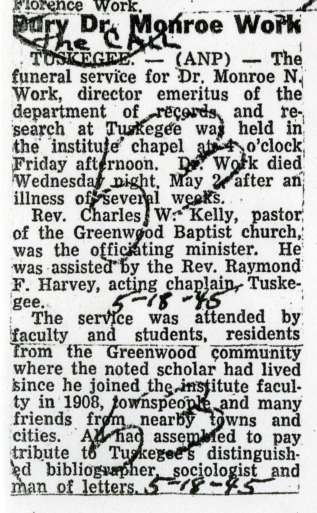
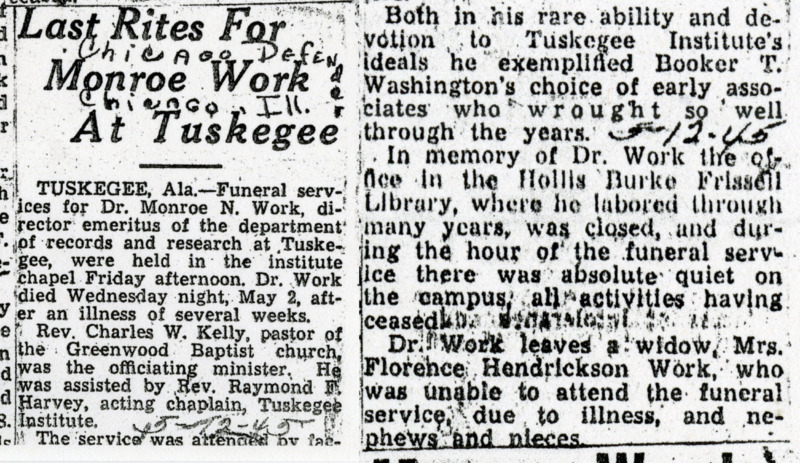
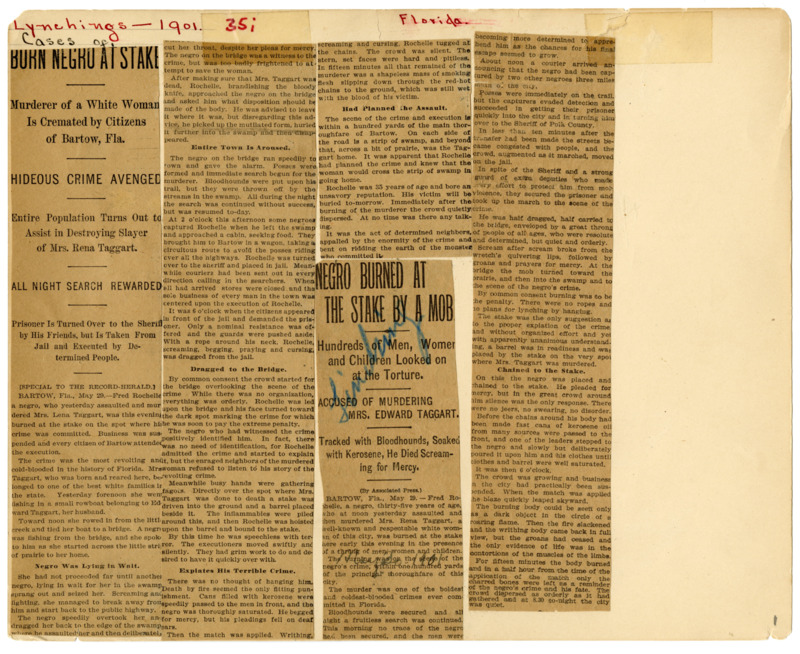
Newspaper article about Monroe Work's funeral service at Tuskegee. The article mentions two ministers who officiated Work's service: Charles W. Kelly and Raymond F. Harvey. The service was attended by faculty, students, and members of the Greenwood community.
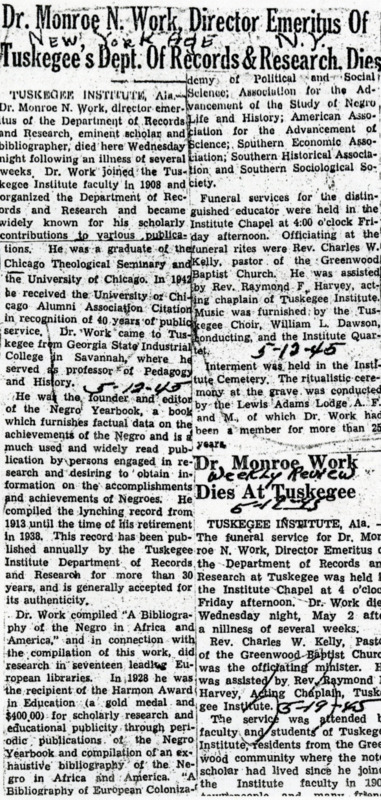
Newspaper obituary for Monroe N. Work. Article mentions Mr. Work's funeral service at Institute Chapel and internment at Institute Cemetery. Charles F. Kelley and Raymond F. Harvey officiated the service, while the ceremony at the grave was led by the Lewis Adams Lodge, A. F. and M.
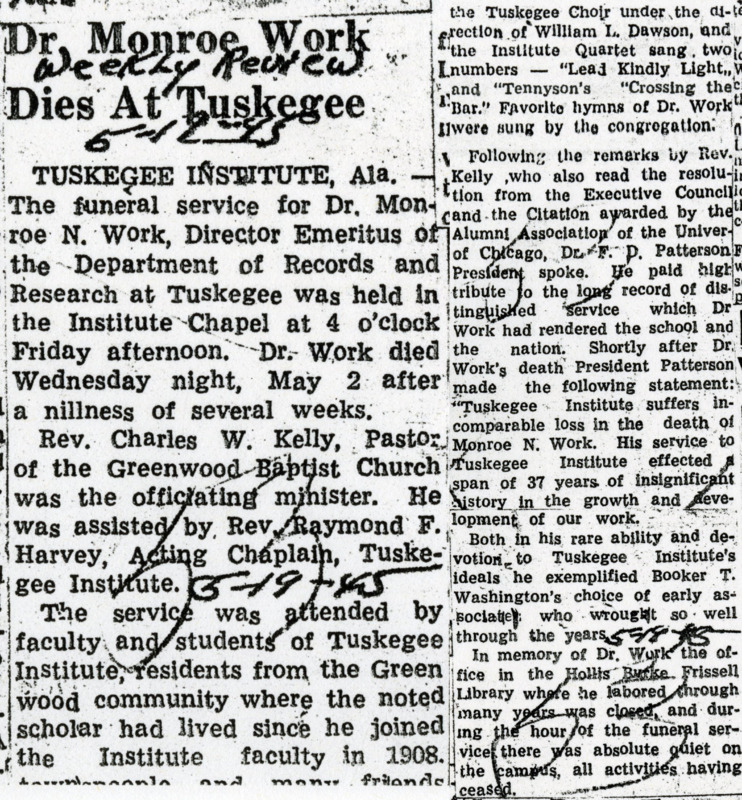
Newspaper article about Monroe N. Work's funeral service at Tuskegee. Article includes a statement from Tuskegee President, Dr. Frederick D. Patterson regarding Work's death. Article also states that the office in Hollis Burke Frissell Library was closed in memory of Mr. Work.
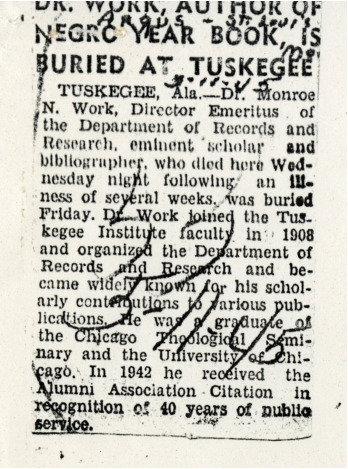
Newspaper article discussing Monroe N. Work's burial, professional activities, and education. Article also mentions Work's 1942 Alumni Association Citation for 40 years of public service.
Newspaper article about Monroe N. Work's funeral service at Tuskegee. Article states that the office in Hollis Burke Frissell Library was closed in memory of Mr. Work and that Mrs. Florence Work was unable to attend the service due to illness.
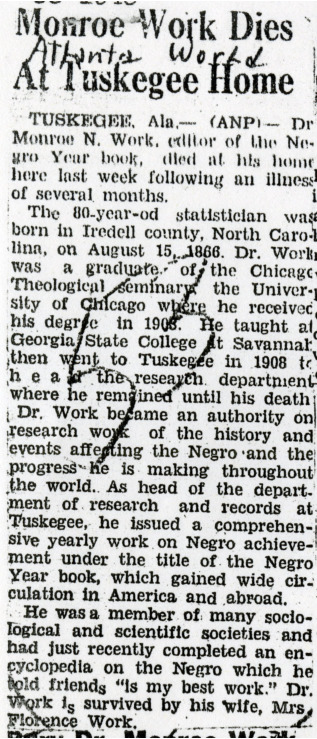
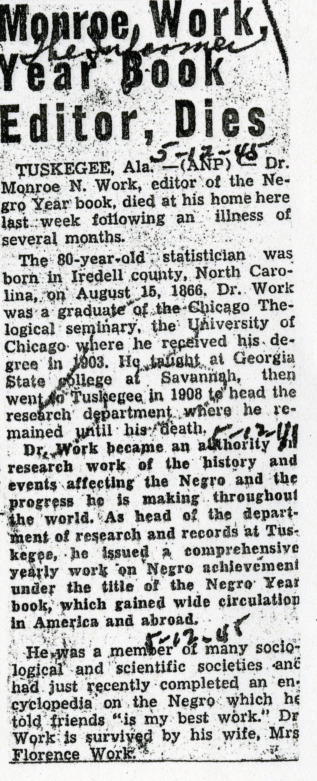
A newspaper obituary article about Dr. Monroe N. Work, a sociologist who founded the Department of Records and Research at Tuskegee University. This article discusses his birthplace, education, and professional achievements throughout his life.
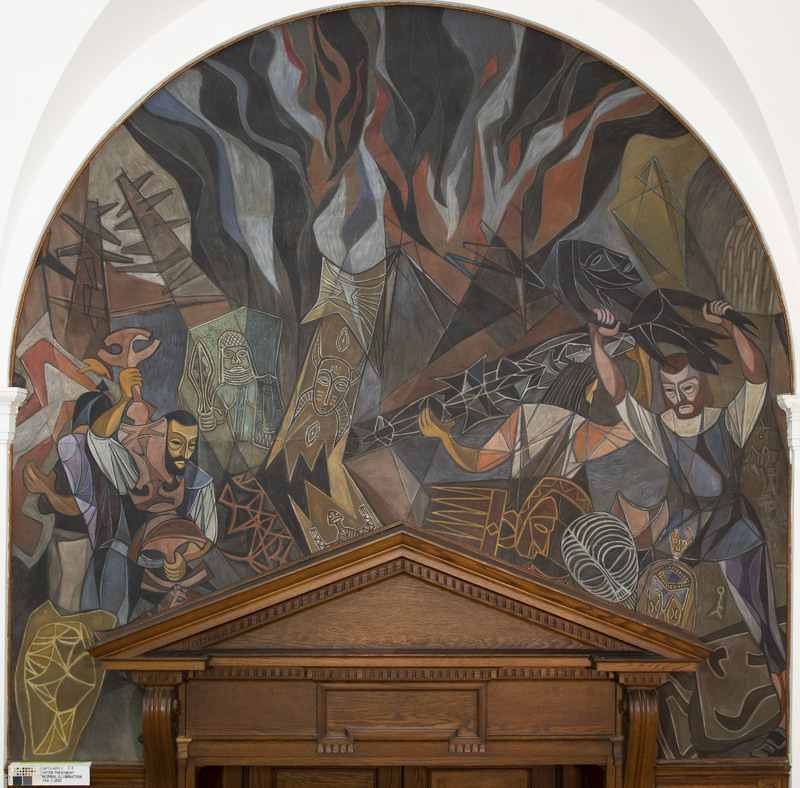
Hale Aspacio Woodruff was an artist and art educator known for his murals, paintings, and prints from Cairo, IL. "Dissipation," the third panel in the Art of the Negro mural series, portrays the theft and disruption of African art and culture by Europeans through colonization.
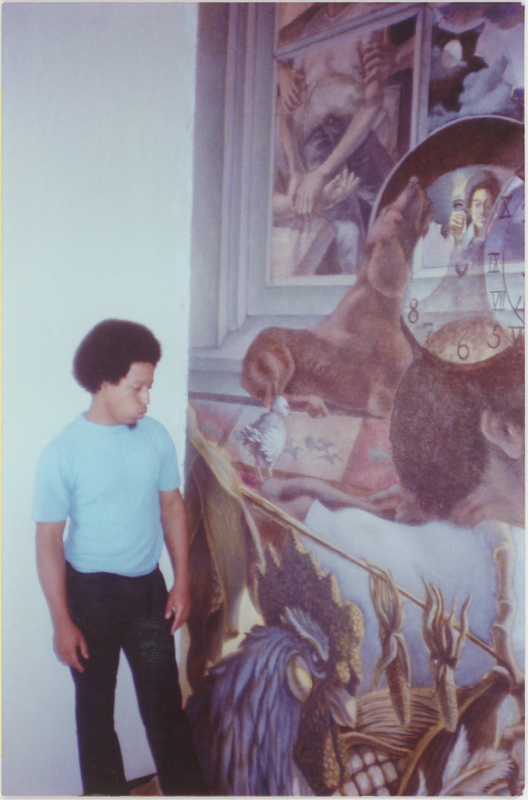
Texas Southern art alumnus Bertram (Bert) Samples is pictured here admiring his mural, which he painted on a first floor wall of Hannah Hall. Samples' mural shows the artist sleeping on his desk after his mother died, dreaming and remembering moments from his life. Samples went on to become one of the founders of Project Rowhouses, a Third Ward-based community art and social impact organization.
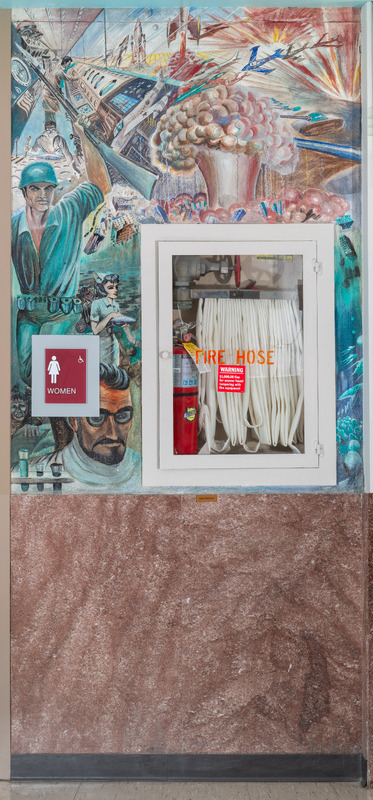
Portraying the brutality of war in the mid-twentieth century, McCowan, a veteran, integrates the wall’s architectural elements (a fire hose and extinguisher) to highlight the tension of the scene. The mushroom cloud above the fire hose highlights Cold War-era anxieties.
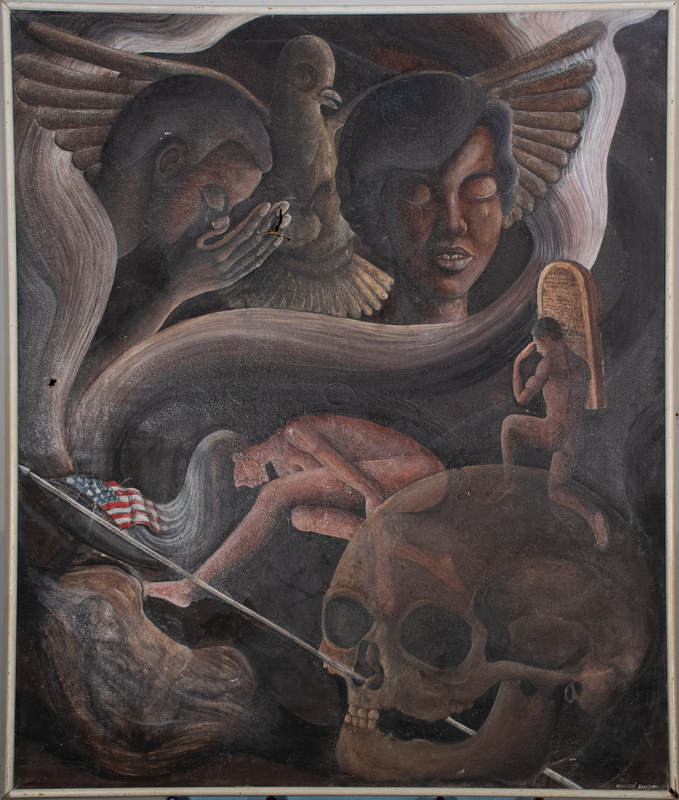
Ellison’s painting reflects the brutality and grief experienced by the Black community. In the foreground, a skull is pierced by the American flag. On the right side, a headstone honoring Martin Luther King, Jr. is surrounded by nude mourners. In the background, a shadowy dove spreads its wings, perhaps representing MLK’s dream of peace being obscured by white supremacist violence.
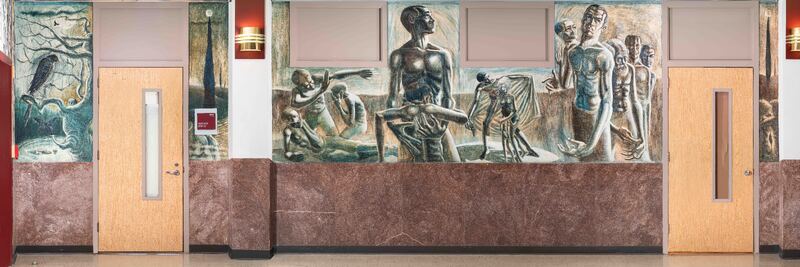
This is a universal scene of the despair and struggle facing a group determined to survive. The lone tree in the moonlight starkly symbolizes the darkness surrounding the scene (center left panel), while the tree rising from a swamp (leftmost panel) suggests hope with the bird, butterfly, and waterlily indicating transformative beauty.
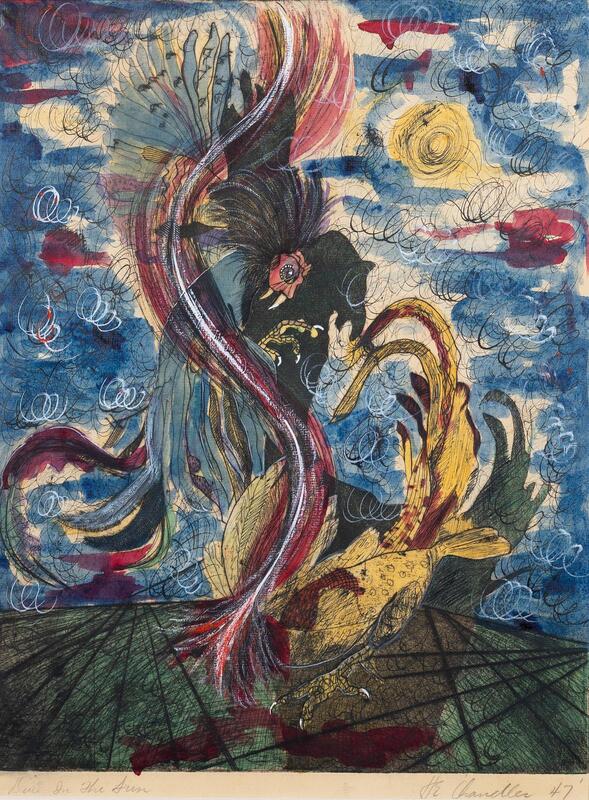
Houston Chandler was a sculptor, printmaker, painter, and teacher from Saint Louis, MO. "Duel in the Sun" is a print artwork of an avian battle on an abstracted landscape. One colorful rooster looks down upon the other it just defeated. The roosters are set on a green field against a blue sky with a swirling yellow sun.
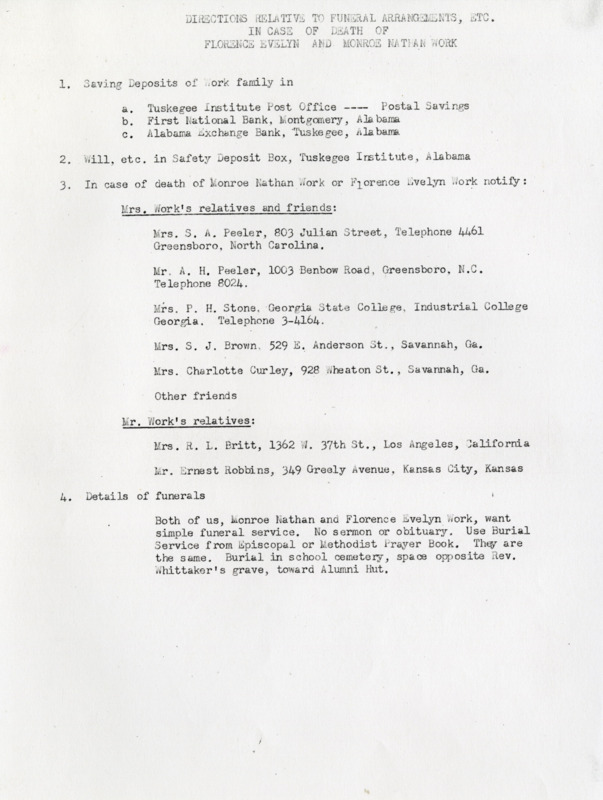
Two-pages of directions in case of the death of Florence Evelyn and Monroe Nathan Work. Contains information on the Work family's saving deposits, will, next-of-kin contacts, and details for funeral services.
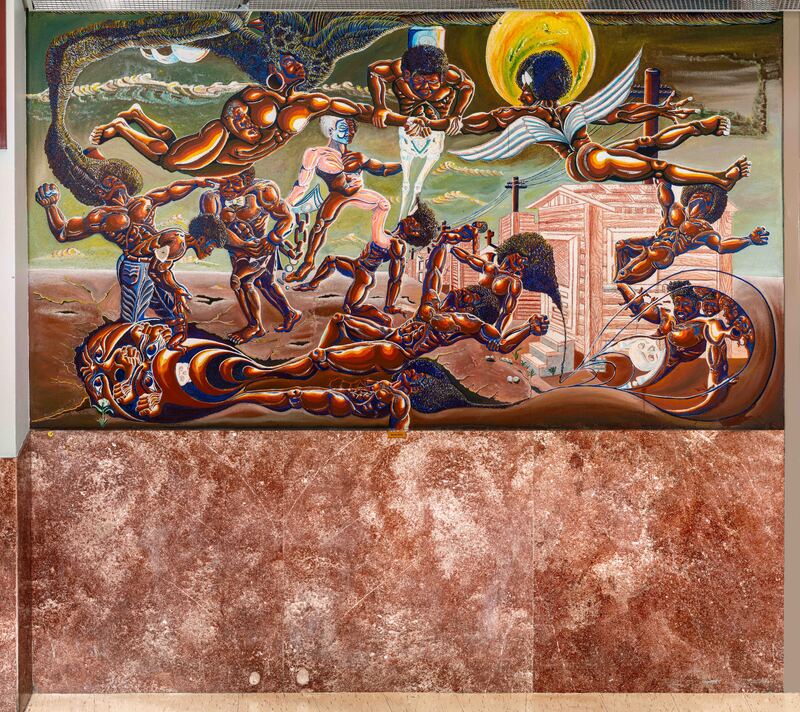
Set against a background of shotgun houses, Black people engage in a struggle to break free from chains and physical limitations. Extreme musculature and angel wings suggest supernatural strengths. A motif in Settles’ work is the power and beauty of Black hair.
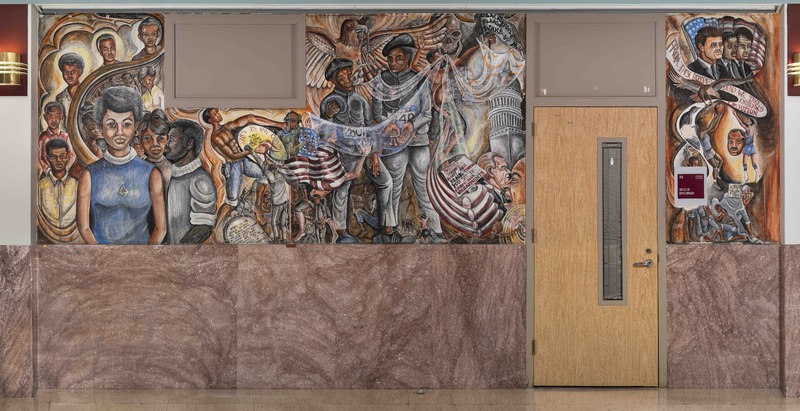
Ellison’s pair of murals speaks to political and social issues of the 1960s and 1970s. The murals express hope through resistance, in spite of the challenges facing Black America. In the middle, a bald eagle holds a broken lynch rope in its beak and “the law” in its talons.
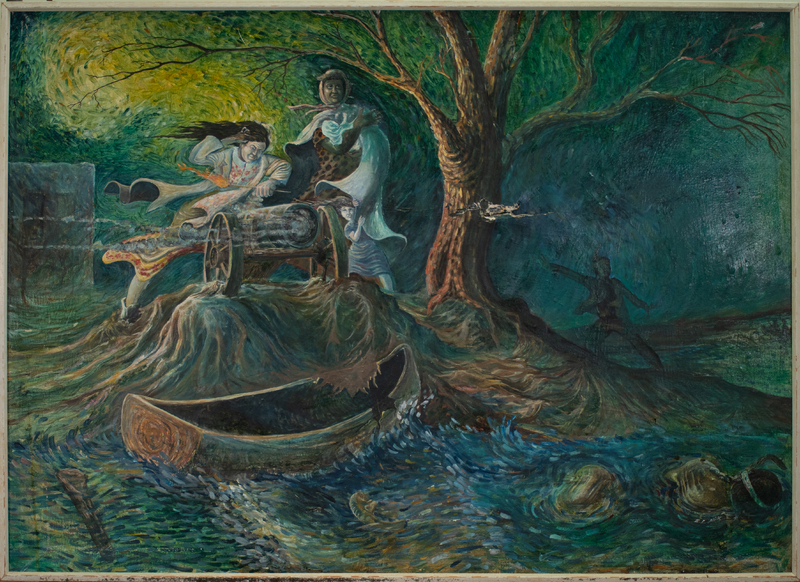
Mills paints a compelling and complex commentary on violence against indigenous people in the United States. In the foreground, a lifeless indigenous person floats next to a wrecked canoe. In the center, a white woman prepares to fire a cannon, still smoking from its last round. Behind her, a stoic Black woman holds one white baby and shelters another white child within her cloak. In the background, a faceless indigenous person reaches towards the scene.
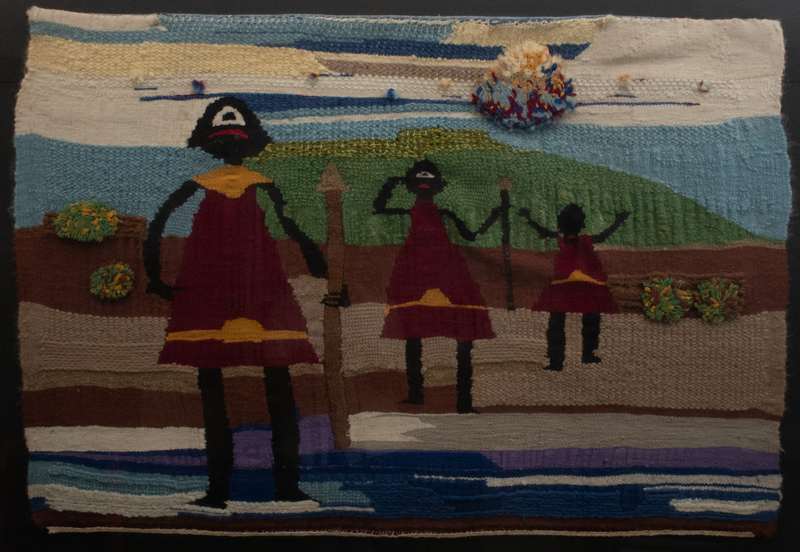
Cole blends weaving methods with surrealist elements in this piece. The work depicts three cyclopes, mythological figures with one eye in the center of their foreheads, standing on a shore. Two of them are holding spears, while a meteor hurtles through the sky. The frowning faces of the figures add to the sense of impending doom.
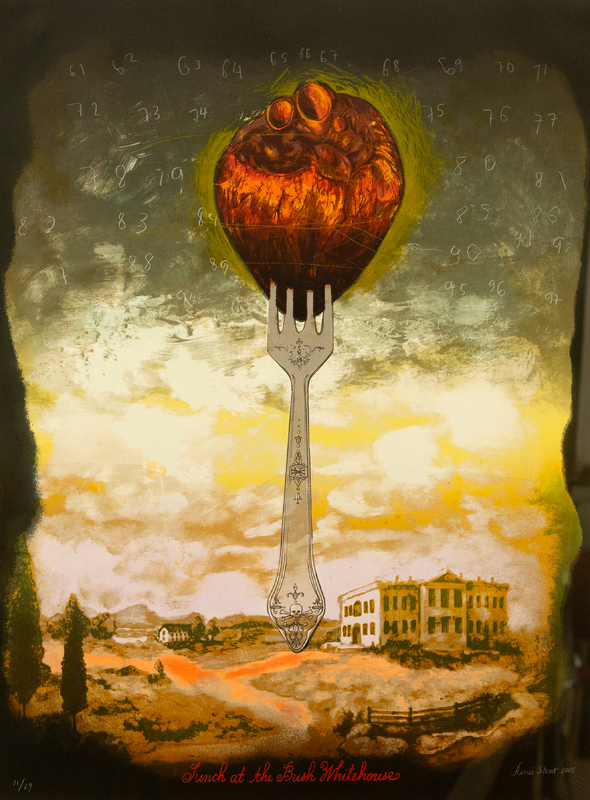
Renee Stout is an artist and sculptor from Junction City, KS. Lunch at the Bush White House is a conceptual gothic painting that explores the intersection of Stout's critique of the Bush administration and numerology from an atmospheric perspective. Above a plantation-like landscape, Stout depicts a heart impaled by an ornate fork.
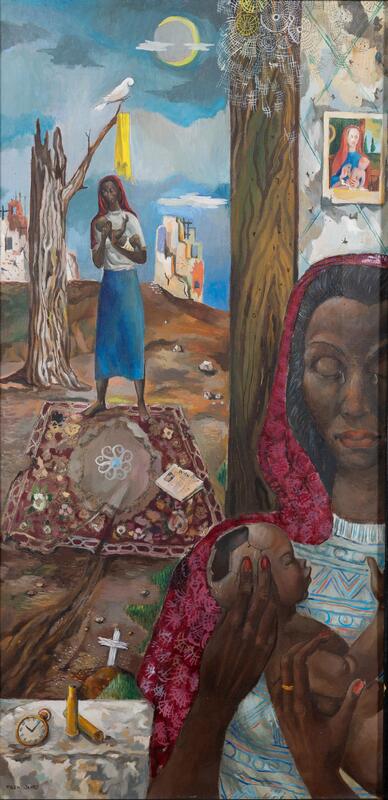
Frederick D. Jones, Jr. is a twentieth-century artist from Chicago, Ill. Madonna Moderne depicts surrealist vignettes of a Black Madonna and child. The piece shows a veiled mother holding an injured baby and the same pair at a gravesite in a war-torn landscape. Jones also includes symbols of purity, humanity, war, and mortality.
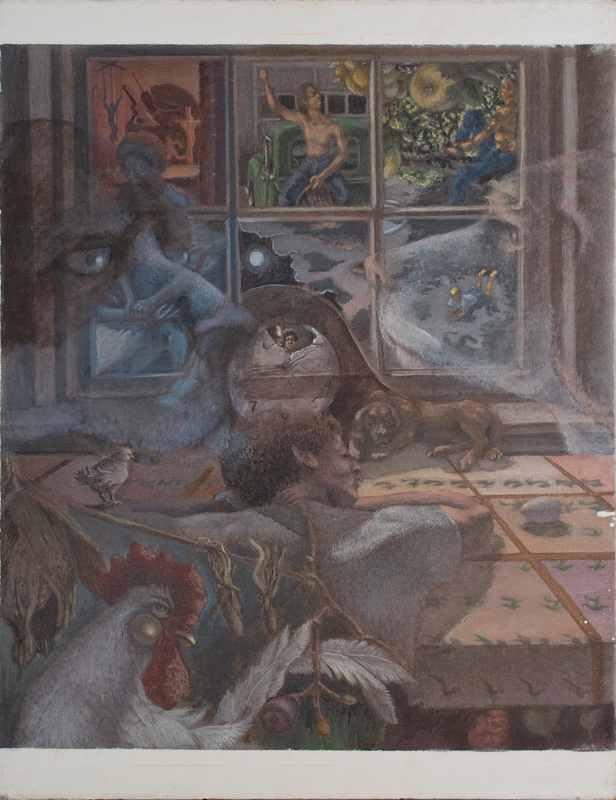
Samples' painting is a study of his mural created in Hannah Hall. The design unfolds like a dream, with each panel above the central figure (the artist himself), who is asleep on a table, revealing a constellation of scenes from the artists’ youth. Lower window panels evoke a harmonious existence with nature and animals, while upper panels reveal struggles with racism in the South and his mother’s death. The shadowy dogs along the sides of the study were not included in the final mural.
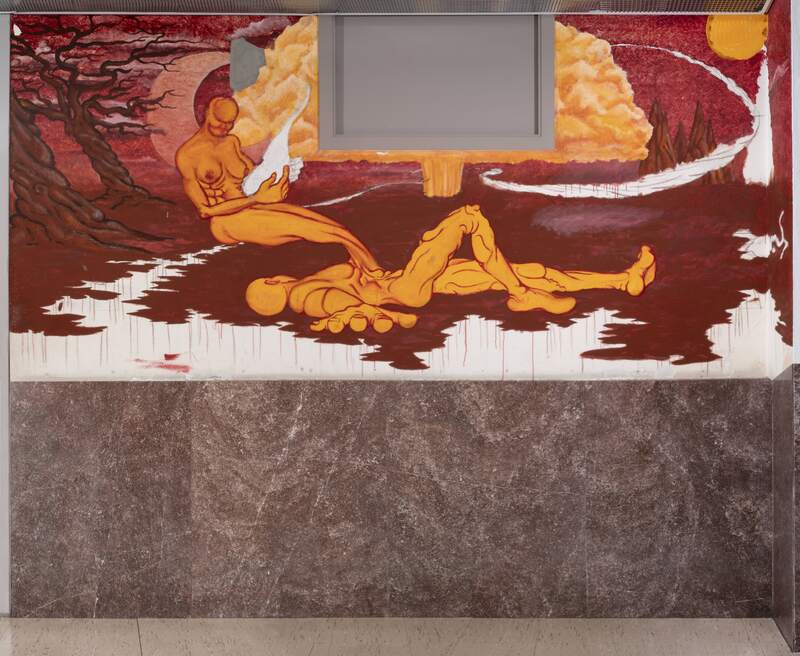
The red and orange-hued apocalyptic scene shows the moments after an explosion. In the middle, a dying woman’s soul leaves her body. The mural appears to have been left unfinished, as the baby, one hand, and parts of the foreground and background are not painted in.
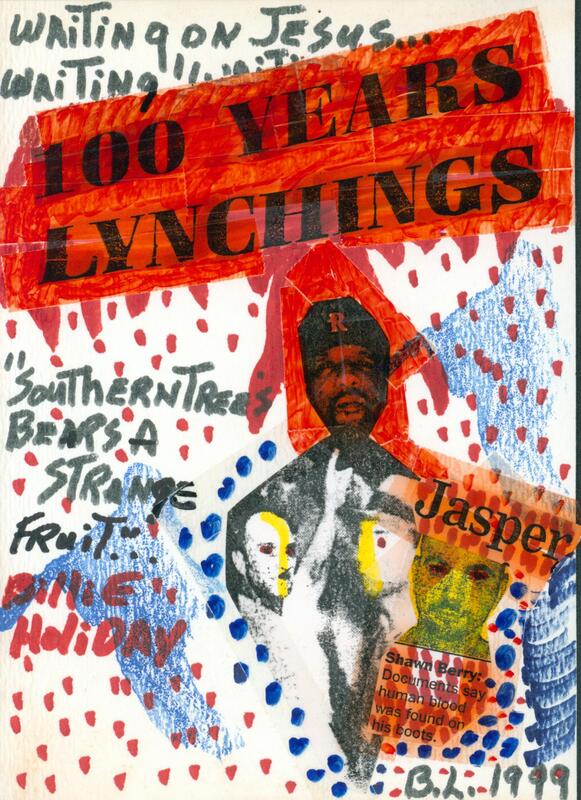
Lee’s collage speaks to the 1998 lynching of James Byrd, Jr., in Jasper, Texas. Byrd’s murder provided part of the impetus for the passage of stronger anti-hate crime laws in Texas and federally. The collage references the anti-lynching poem/song “Strange Fruit,” made famous by Billie Holiday. Lee, sometimes called “Da Mayor of Fifth Ward,” grew up in Houston’s Fifth Ward, but his family traces its roots to Jasper, where three white supremacists lynched Byrd and desecrated his body.