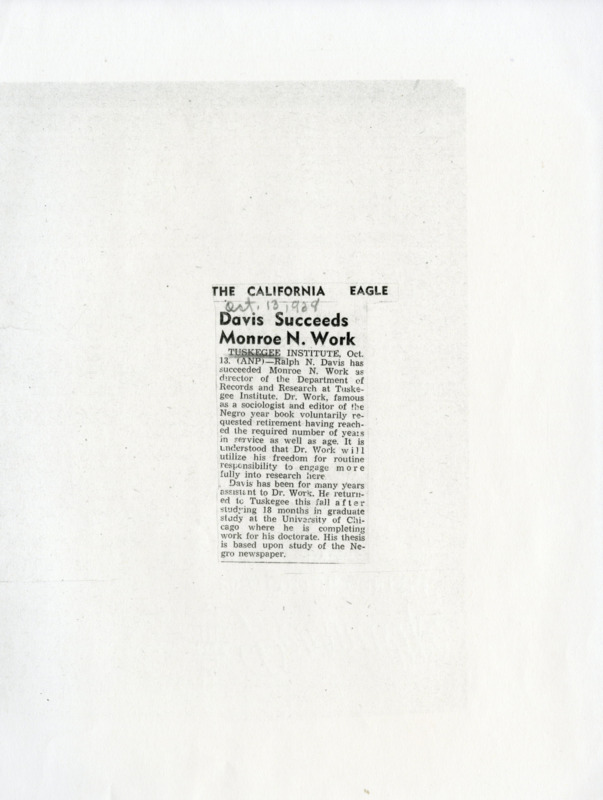
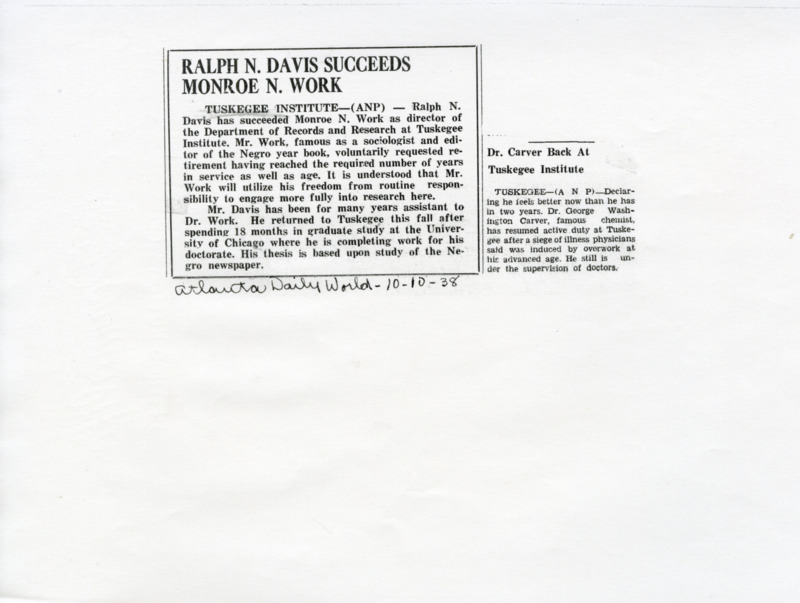
Newspaper article about the new director for Tuskegee's Department of Records and Research, Ralph N. Davis. Mentions Monroe N. Work's retirement and that Davis worked as Work's assistant for many years.
A newspaper article announces Ralph N. Davis as the new director of Tuskegee University's Department of Records and Research. The article highlights his extensive experience as an assistant to Monroe N. Work and notes that he is currently completing his graduate degree at the University of Chicago.
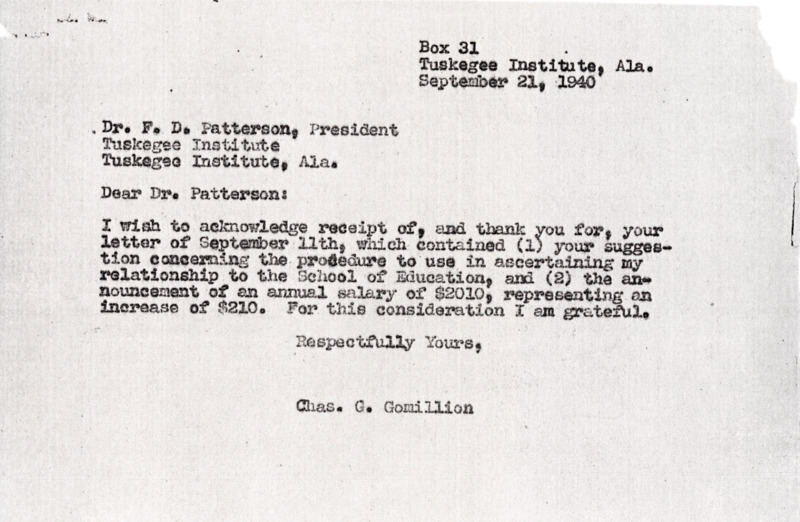
A letter from Charles G. Gomillion to President Frederick D. Patterson acknowledging his receipt of the 09/11/1940 letter and accepting increase in pay to continue working at Tuskegee.
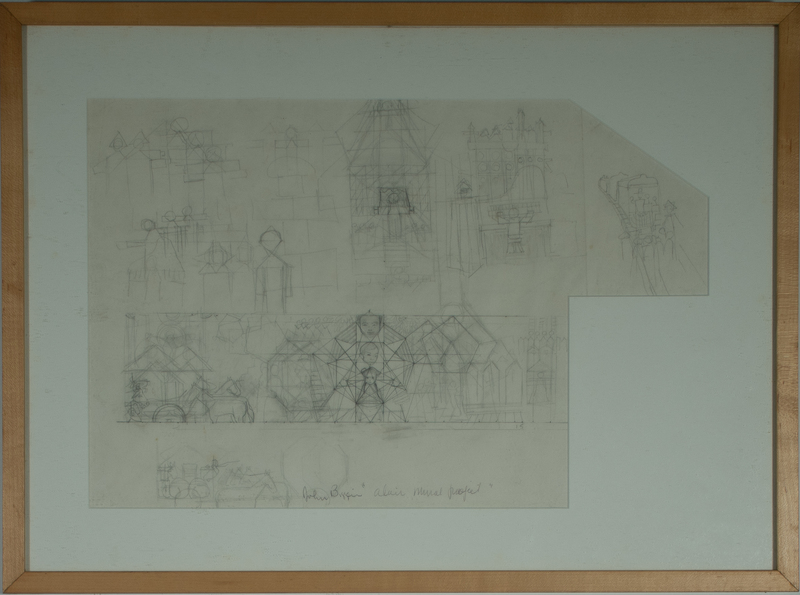
This sketch by John Biggers is part of his planning process for his mural in Christia V. Adair Park, named for an iconic Houston civil rights activist. As part of this project, Biggers also designed a pavilion to contain this mural, drawing inspiration from the homes of the Dogon people of Mali. The mural itself features scenes from Adair's life interspersed with Biggers's own Afrocentric iconography.
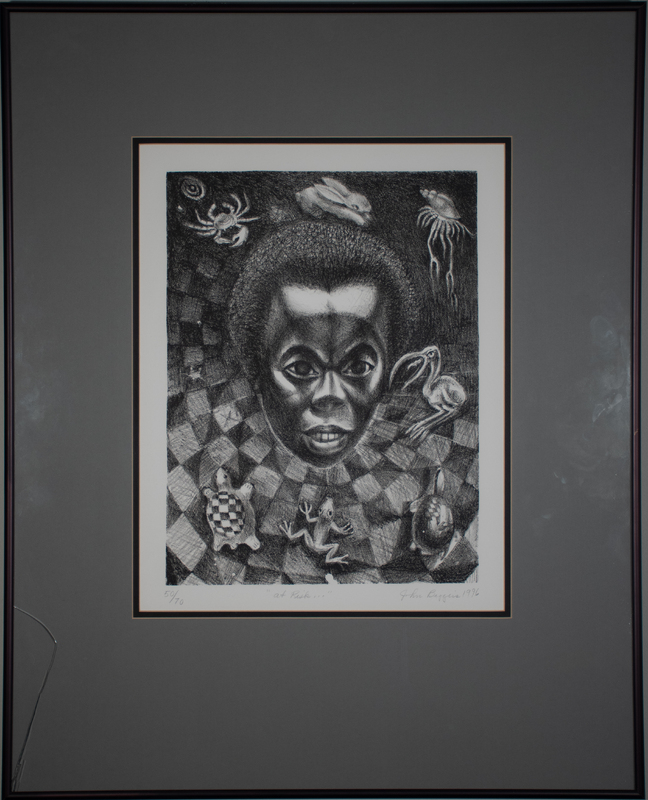
This Biggers print shows a person's head surrounded by animals and a checkerboard. Checkerboards and swirls are common motifs in Biggers' work, which he referred to as sacred geometry. The pictured animals are symbolic; for instance, tortoises represent longevity and rabbits represent bad omens.
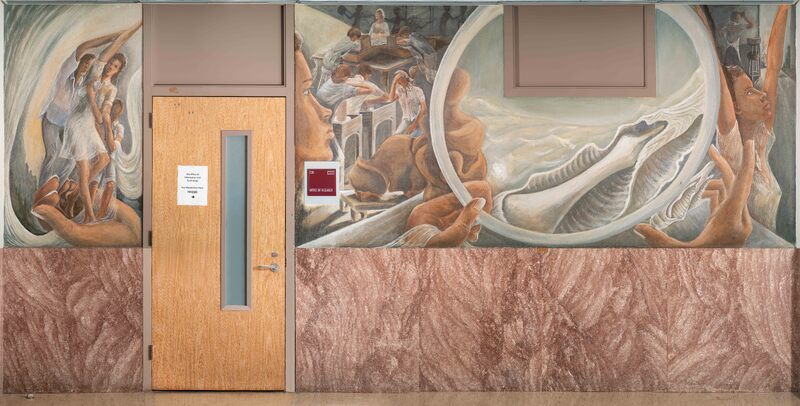
Gordon’s mural examines her own life and personal development. A wispy fabric running through the mural serves as a metaphor for her emerging self-awareness; this motif is found in some of her other works. Gordon’s mural showcases herself working on several art projects from her undergraduate period.
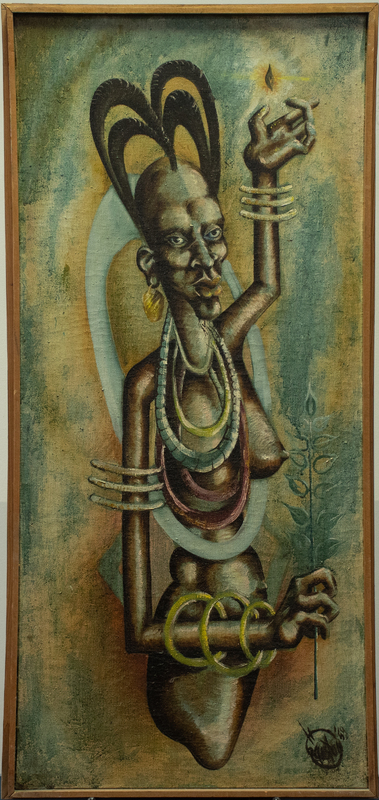
Michaux’s painting shows a nude woman draped with jewelry from her ears, neck, and arms. In her right hand, she holds a branch with leaves; a small flame extends from her left hand, above her head. After graduating from Texas Southern, Michaux went on to teach art at several universities, including HBCUs Southern University, North Carolina Central University, and South Carolina State University.
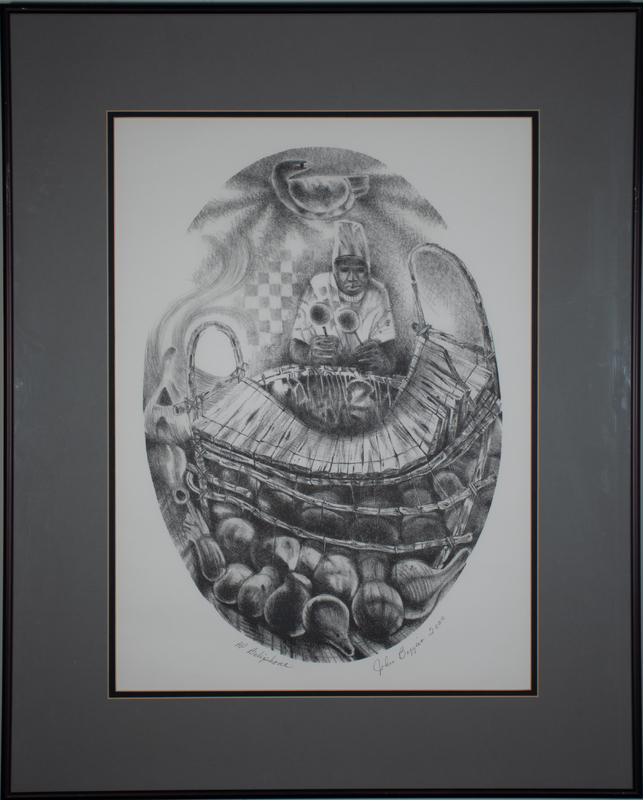
This Biggers print shows a figure playing a balafon, with a sankofa bird overhead. The balafon is a West African percussion and the sankofa bird signifies the importance of the past in improving the future. Taken together, they show the importance of music in preserving culture.
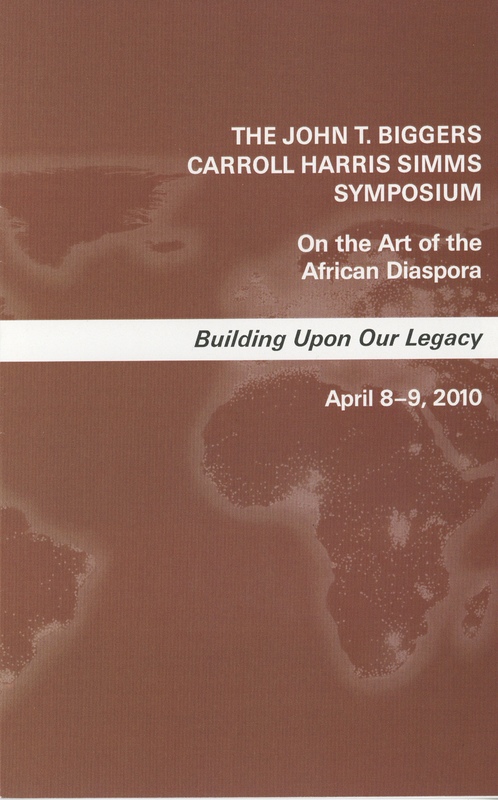
This is a brochure for the April 2010 John T. Biggers Carroll Harris Simms Symposium On the Art of the African Diaspora: Building Upon Our Legacy. This regular event from the University Museum at Texas Southern brings together artists, historians, educators, students, alumni, and members of the public to celebrate the legacy of Biggers and Simms, who worked together to build TSU’s art department from the ground up.
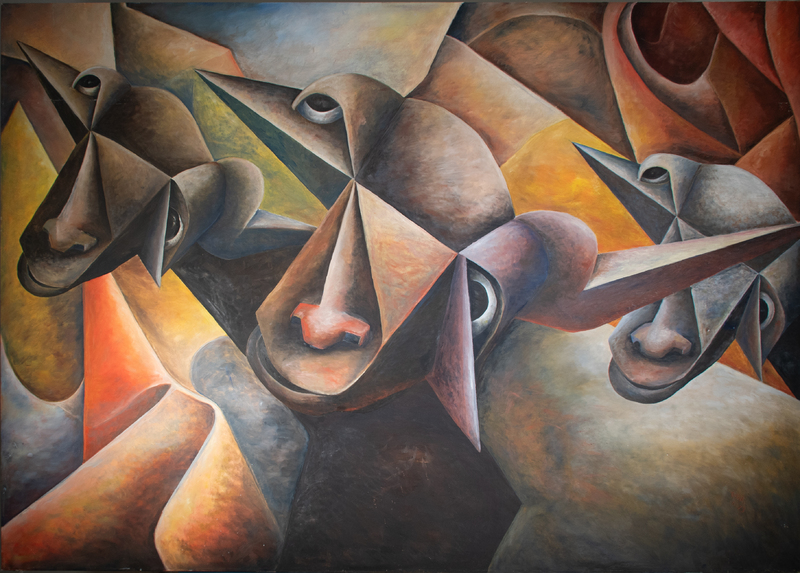
This abstract work features three distorted cows’ faces that seem to be staring upwards and at the viewer, against a colorful triangular background. Vital was an art student at Texas Southern and later went on to become a faculty member in the art department. Many works in the school’s collection, particularly from the 1970s, use cubist styles.
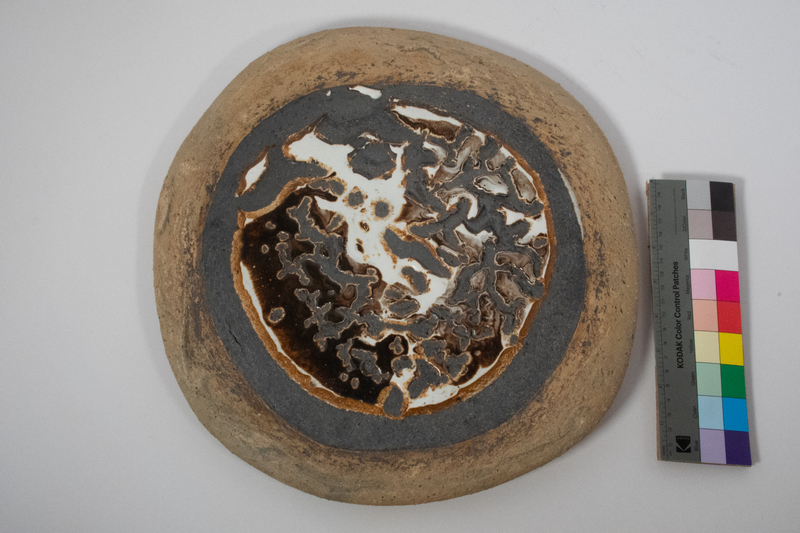
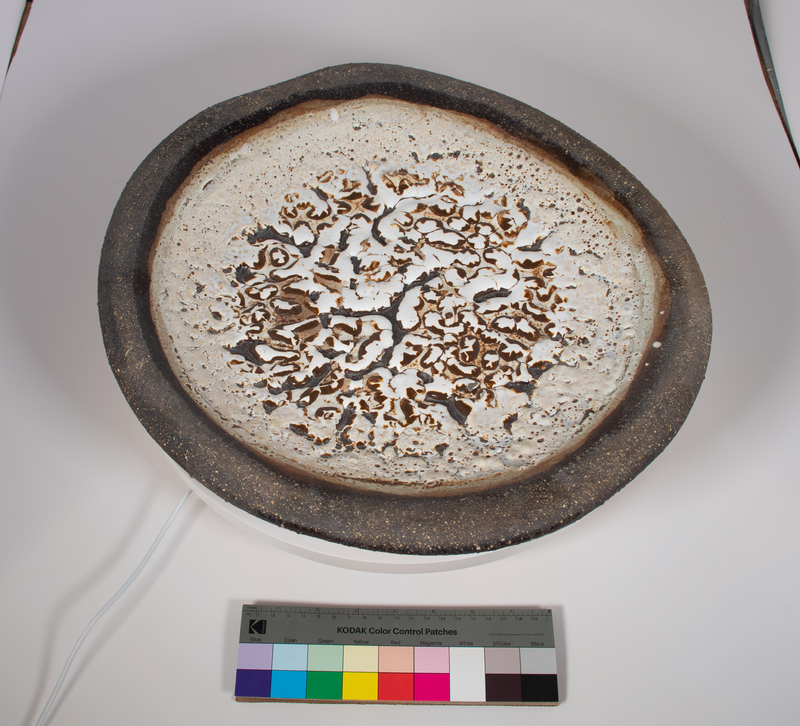
This large ceramic plate created by Carroll Harris Simms features multiple textures, including a bubbling glaze covering most of the top of the piece. Simms worked alongside Dr. John T. Biggers to build Texas Southern's art department from the ground up. Simms' decorative artworks remain in high demand by collectors.
This large, brown ceramic plate created by Carroll Harris Simms features multiple textures, including a bubbling glaze covering most of the top of the piece. Simms worked alongside Dr. John T. Biggers to build Texas Southern's art department from the ground up. Simms' decorative artworks remain in high demand by collectors.
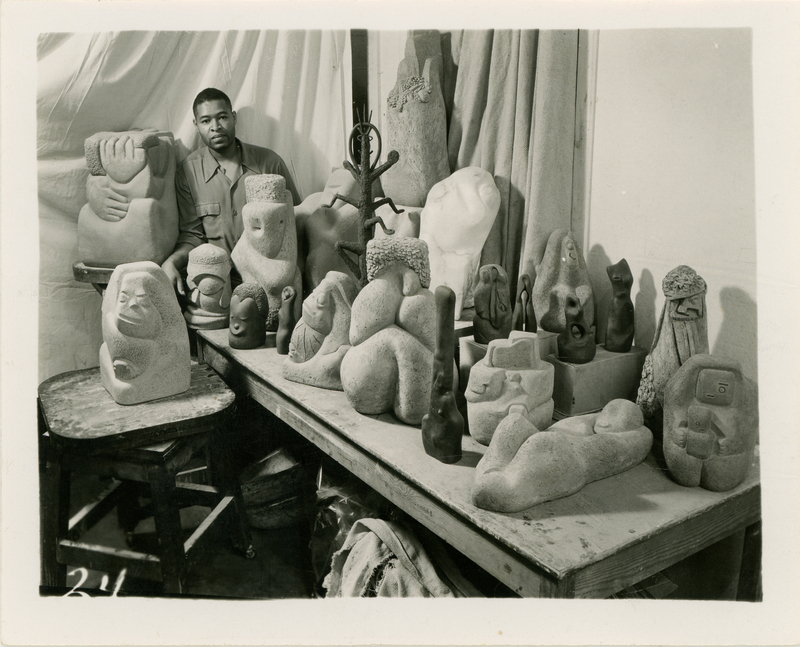
This photograph shows a young Carroll Harris Simms, with many of his sculptures, as an art student at Cranbrook Academy of Art. Simms received his BFA and MFA from Cranbrook, where he was the first African American graduate. Simms recalled the way student and faculty advocates helped him integrate the school. In 1950, Simms came to Texas Southern to help Dr. John T. Biggers run the art department; Simms taught pottery, sculpture, ceramics, and jewelry making classes.
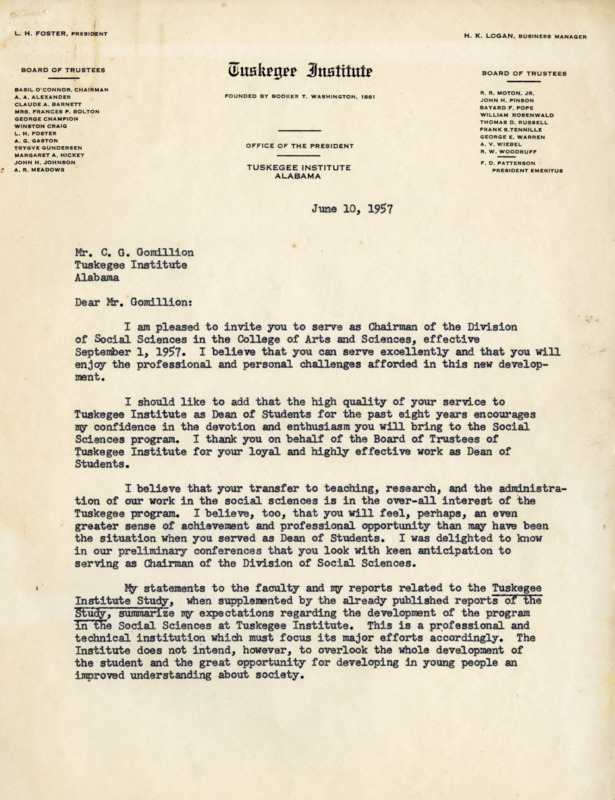
A letter from the university’s fourth president, Dr. Luther Hilton Foster, to Charles G. Gomillion, asking him to serve as Chairman of the Division of Sciences in the College of Arts and Humanities at Tuskegee University.
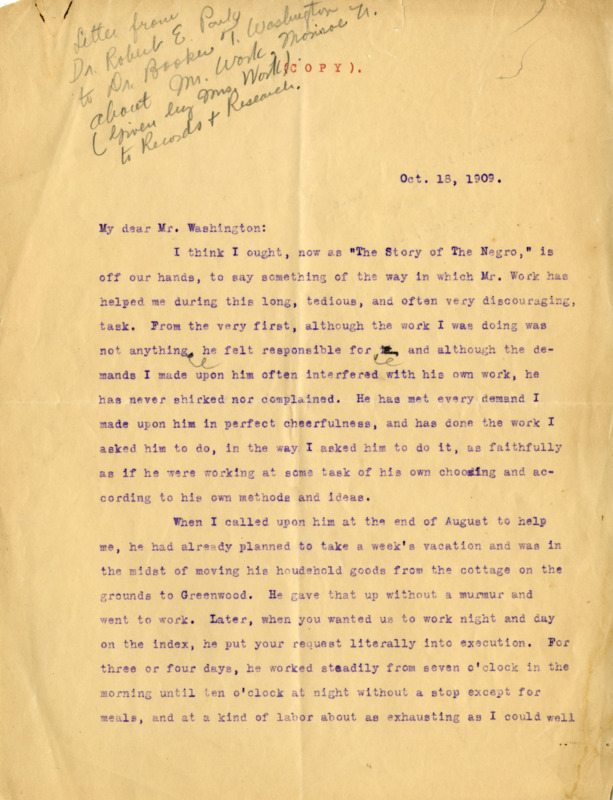
Two-page unsigned letter to Booker T. Washington about Monroe N. Work's help to Robert E. Park during his work on "The Story of the Negro." Park writes about Work's cheerfulness, work ethic, and willingness to help. The letter also mentions a Mr. Scott, Mr. Wood, and Miss Sewall.
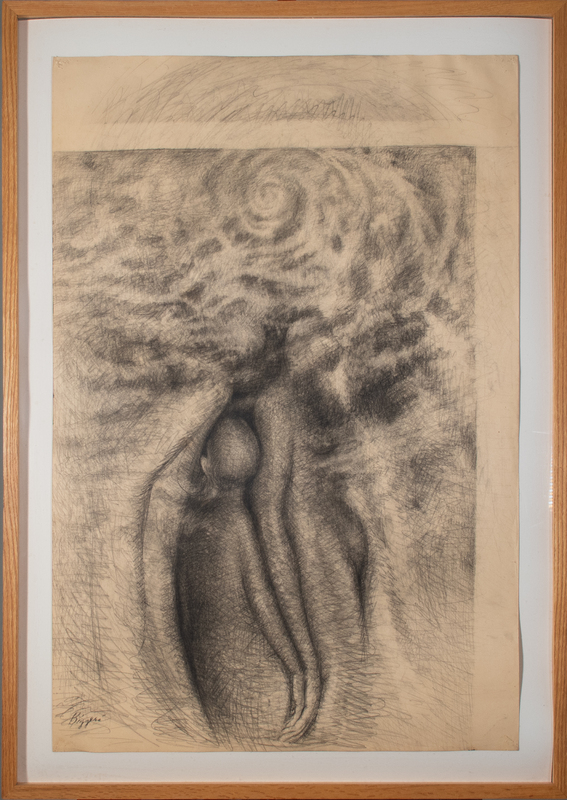
This drawing by Dr. John T. Biggers depicts a family caught up in a wild storm that is swirling around them. Biggers' artwork frequently highlights family dynamics and the centrality of mothers. Biggers appears to have later repurposed this sketch and added additional floral details to create his 1992 print Metamorphosis III.
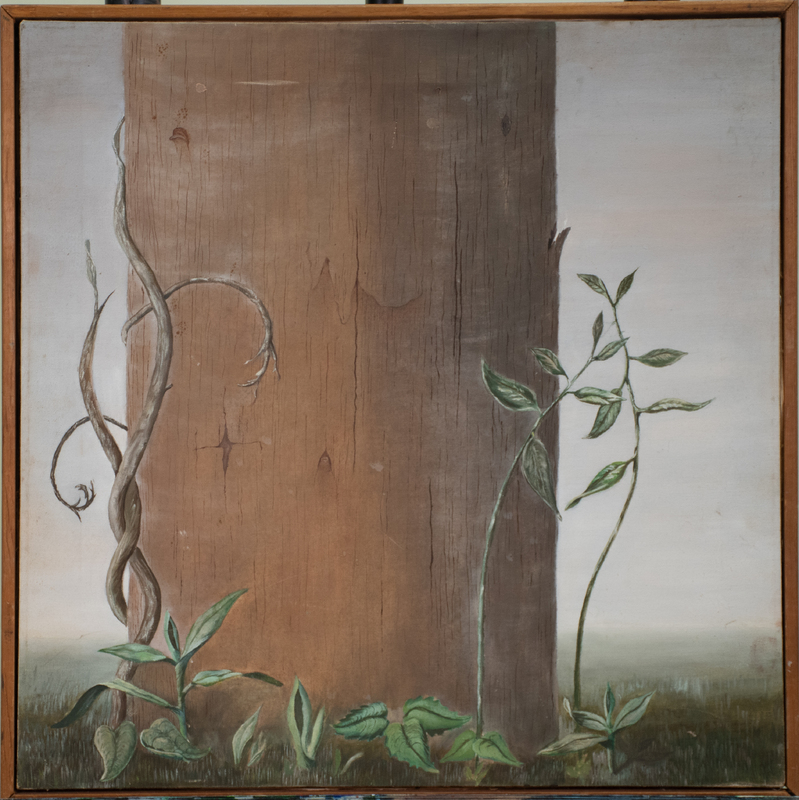
This painting, created by an unknown TSU art student, depicts the base of a tree or wooden telephone pole, with various smaller plants and vines creeping up its structure. Dr. John T. Biggers encouraged students to study the natural world and seek inspiration from it. He instructed students to sit outside for an extended period of time and observe.
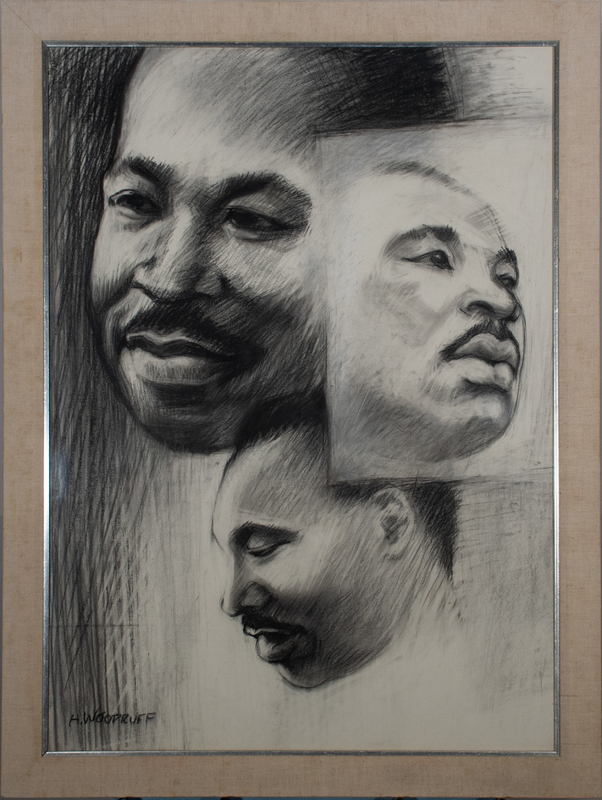
Woodruff’s portrait depicts Martin Luther King Jr., the iconic civil rights leader who was assassinated in 1968. Woodruff taught art at Atlanta University for 15 years and perhaps came into contact with MLK during this time. Two of these three side profiles appear to show King smiling, while in the third he is looking away with a serious expression. Woodruff's Art of the Negro murals at Clark Atlanta University are one of his crowning achievements.
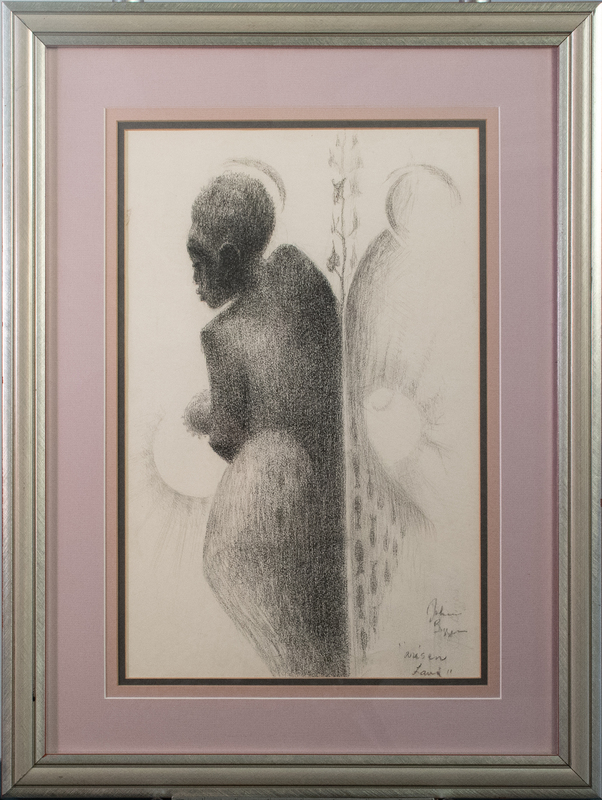
Biggers’ drawing shows a woman and her reflection. The woman, positioned on the left side of the composition, looks slightly back over her left shoulder, while the sun creeps out from around her midsection. The woman is cradling a baby in her arms. Her reflection is drawn loosely with minimal details, and the two are separated by a line of plant and fish shapes.
In this interview, Texas Southern art alumnus Earl Jones, Jr. discusses his experience as a student who graduated in 1996. During his first period of study at TSU, Jones painted a mural reflecting on environmentalism and racism—these themes continue into his current works. Nowadays, Jones primarily creates intricate wood carvings.
In this interview, Texas Southern art alumnus Elizabeth Montgomery Shelton discusses her experiences as a student in the class of 1971. She was a disciple of Professor Carroll Harris Simms and discusses learning to create clay sculptures from him. She went on to teach in Houston public schools for 37 years after her graduation from Texas Southern.
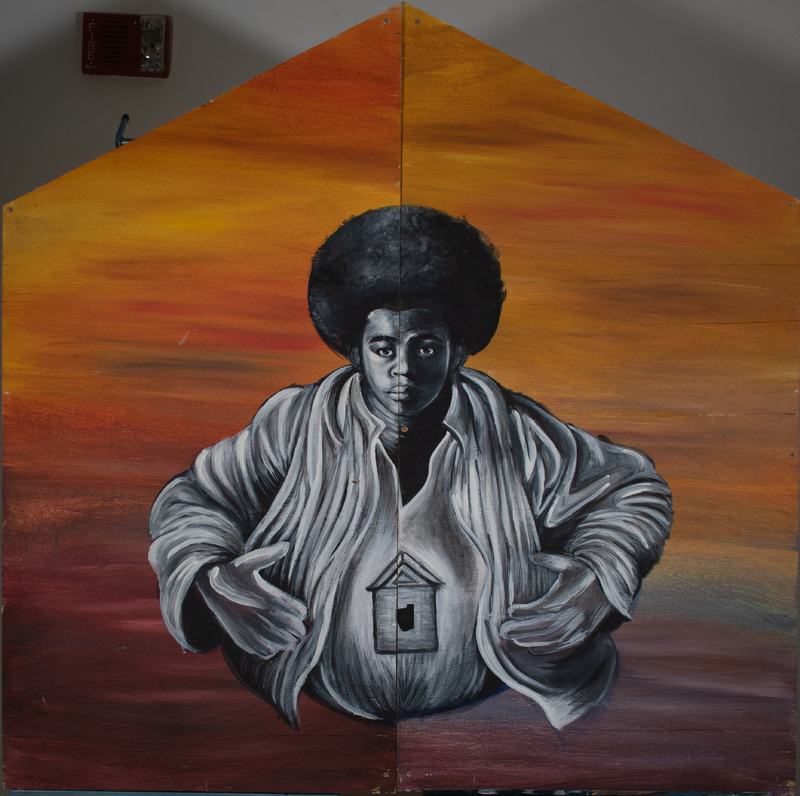
Foster’s painting is inspired by Charles White’s Sound of Silence. Third Ward is the historically Black neighborhood of Houston that Texas Southern calls home. Where White’s original features a seashell, Foster substitutes a rowhouse, the style of homes that are the heart of Third Ward. Dr. John T. Biggers, founder of Texas Southern's art department, studied under White at Hampton University.
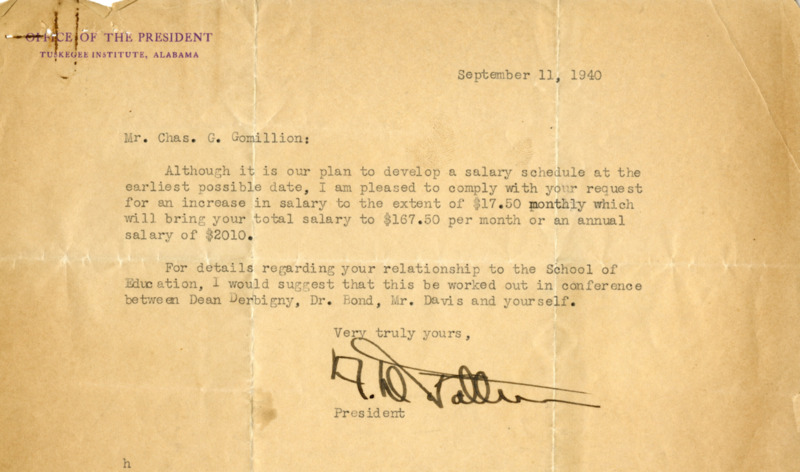
A letter from the third President of Tuskegee University, Dr. Frederick D. Patterson, confirming that Charles G. Gomillion will receive an increase in salary and continue his work at Tuskegee University.
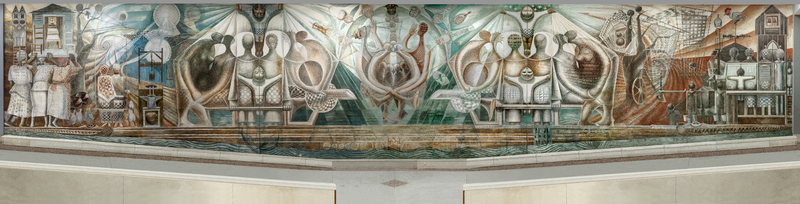
Texas Southern University students commissioned Biggers to paint this mural in the cafeteria of the student center. Composed of several distinct but interrelated images, Family Unity features several Afrocentric motifs that Biggers developed, including sacred geometry (checkerboards and spirals), shotgun houses, and husband-and-wife pairs. At the center is what Biggers called the “morning star,” which shows a couple embracing with their form suggesting a womb.
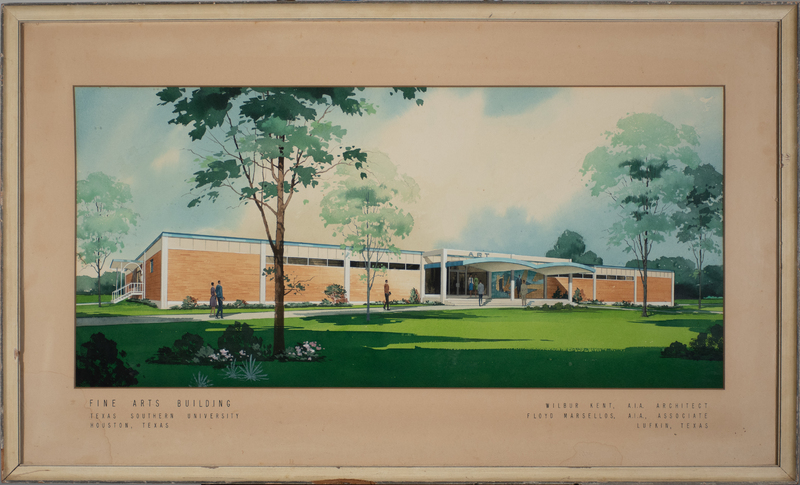
This is an architectural rendering for the Fine Arts Building on Texas Southern’s campus. The building was dedicated as the John T. Biggers Art Center in 1995 to honor the art department’s founder. The building largely retains its original character as depicted in this image.
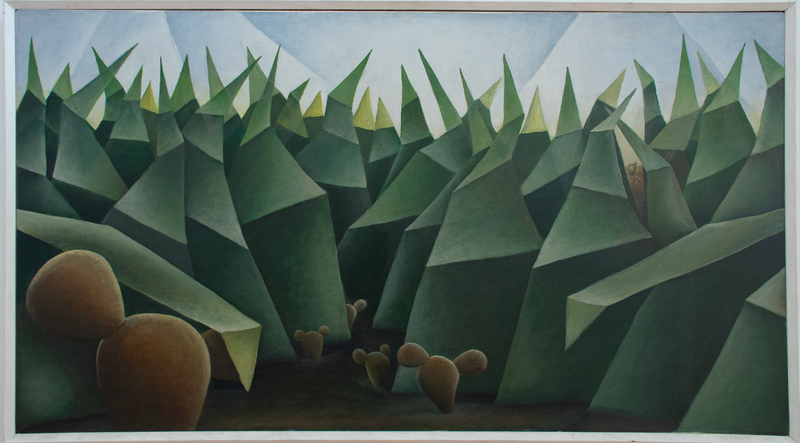
This painting by Jesse Sifuentes shows a landscape scene featuring cactuses. Several TSU art alumni have recalled that Dr. John Biggers taught them based on themes more than techniques. Many works from the 1970s use geometric styles, perhaps a reflection of lessons from the time. Sifuentes went on to become a ceramics professor at Texas Southern.
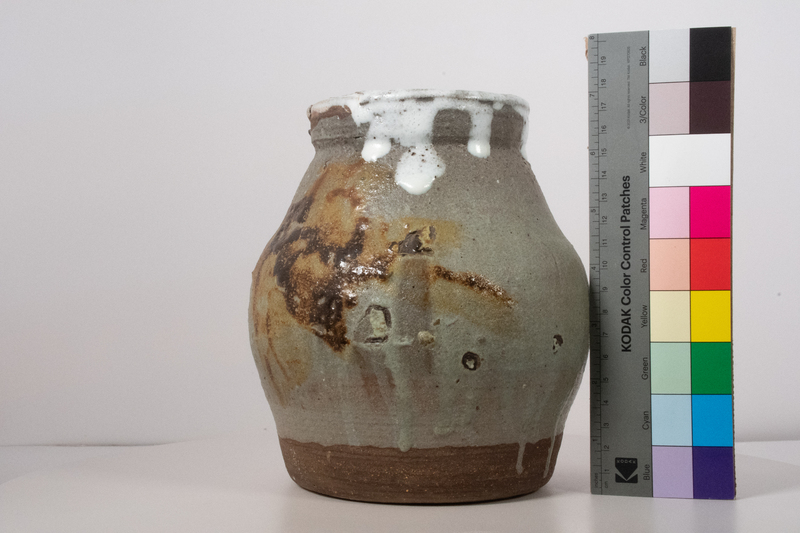
This small ceramic vessel created by Professor Carroll Harris Simms has a green hue, with a brown base and white-glazed lip and interior. Simms believed pottery to be an equally important artistic pursuit to sculpture and was encouraged to hear pottery was held in the same regard in West Africa.
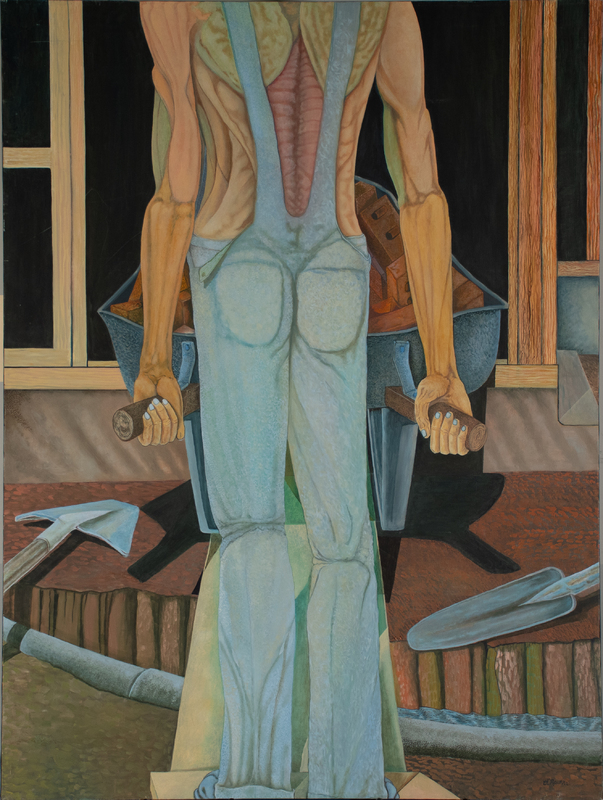
Renfro’s painting displays an image of a working man dressed in overalls from behind. The man is wheeling bricks towards a construction site. His bones and muscles are made visible in the composition, perhaps to highlight the physical demands of his labor. Dr. Biggers taught his students to portray the human form with care and detail, particularly oft-neglected features like hands and feet.
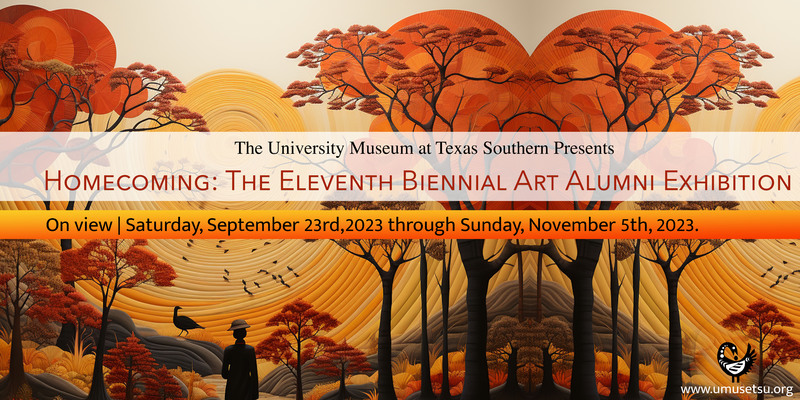
This is a digital flyer for the Fall 2023 Homecoming: The Eleventh Biennial TSU Art Alumni Exhibition at the University Museum at Texas Southern. The University Museum hosts an art alumni exhibition every other fall, alternating with an art faculty exhibition. Alumni showcase their artwork, which ranges from paintings, prints, and photographs to sculpture, jewelry, and wood carving.
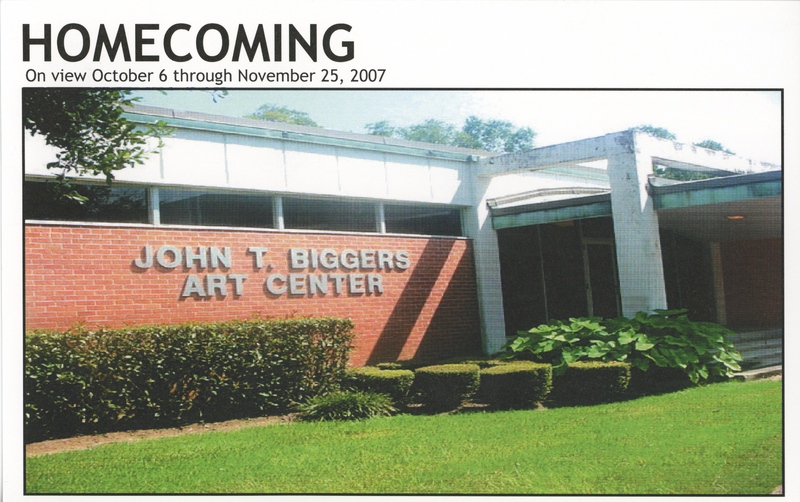
This is an invitation to the Fall 2007 Homecoming: The Third Biennial TSU Art Alumni Exhibition at the University Museum at Texas Southern. The University Museum hosts an art alumni exhibition every other fall, alternating with an art faculty exhibition. Alumni showcase their artwork, which ranges from paintings, prints, and photographs to sculpture, jewelry, and wood carving.