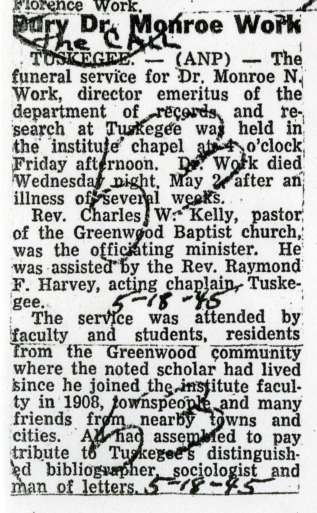
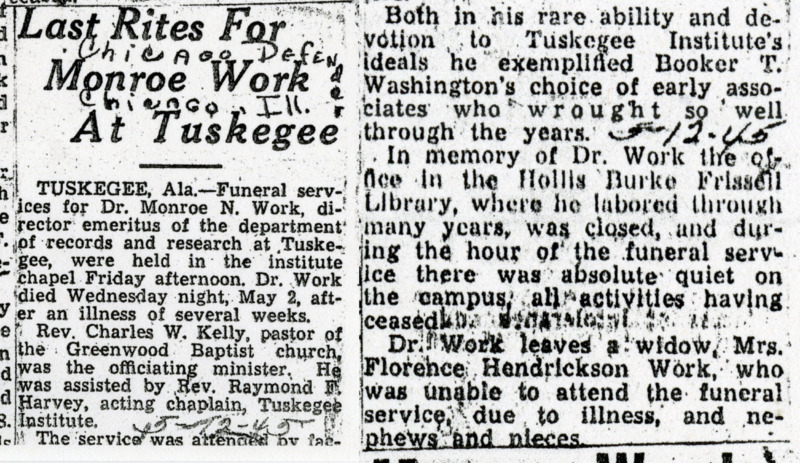
Newspaper article about Monroe Work's funeral service at Tuskegee. The article mentions two ministers who officiated Work's service: Charles W. Kelly and Raymond F. Harvey. The service was attended by faculty, students, and members of the Greenwood community.
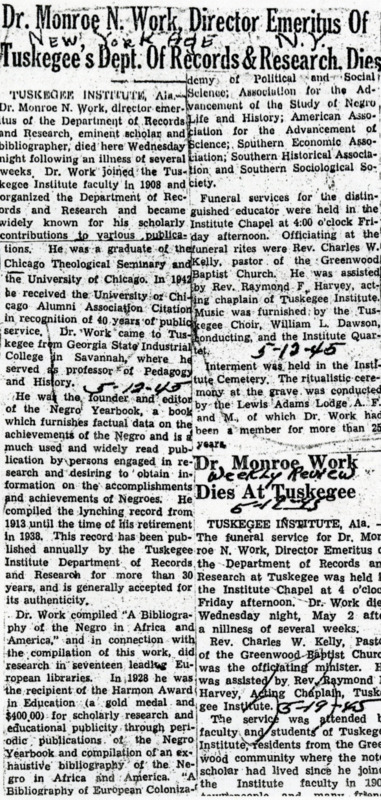
Newspaper obituary for Monroe N. Work. Article mentions Mr. Work's funeral service at Institute Chapel and internment at Institute Cemetery. Charles F. Kelley and Raymond F. Harvey officiated the service, while the ceremony at the grave was led by the Lewis Adams Lodge, A. F. and M.
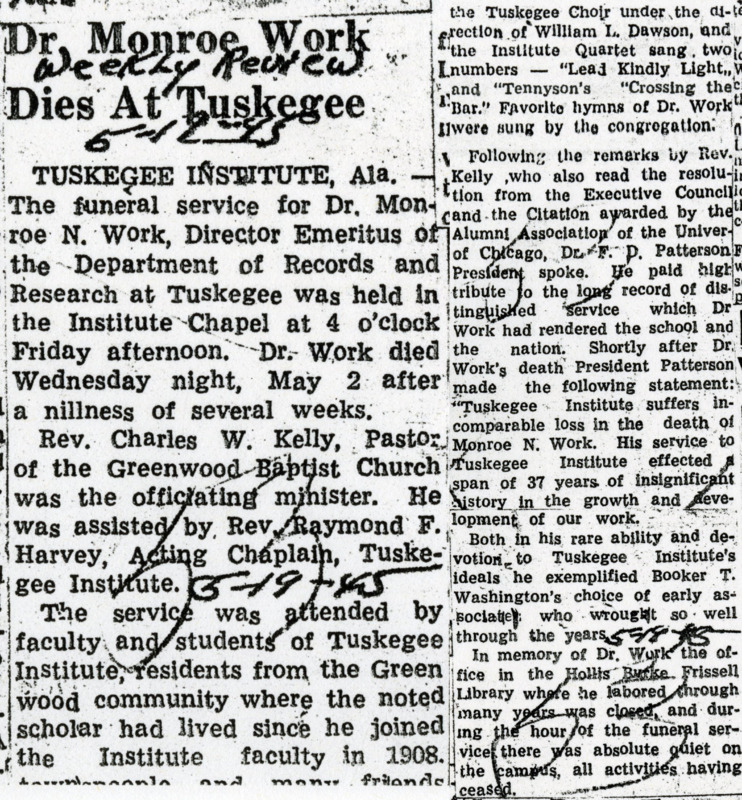
Newspaper article about Monroe N. Work's funeral service at Tuskegee. Article includes a statement from Tuskegee President, Dr. Frederick D. Patterson regarding Work's death. Article also states that the office in Hollis Burke Frissell Library was closed in memory of Mr. Work.
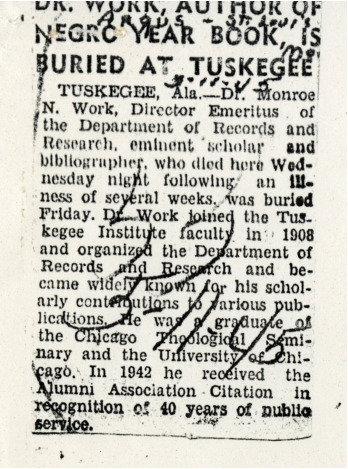
Newspaper article discussing Monroe N. Work's burial, professional activities, and education. Article also mentions Work's 1942 Alumni Association Citation for 40 years of public service.
Newspaper article about Monroe N. Work's funeral service at Tuskegee. Article states that the office in Hollis Burke Frissell Library was closed in memory of Mr. Work and that Mrs. Florence Work was unable to attend the service due to illness.
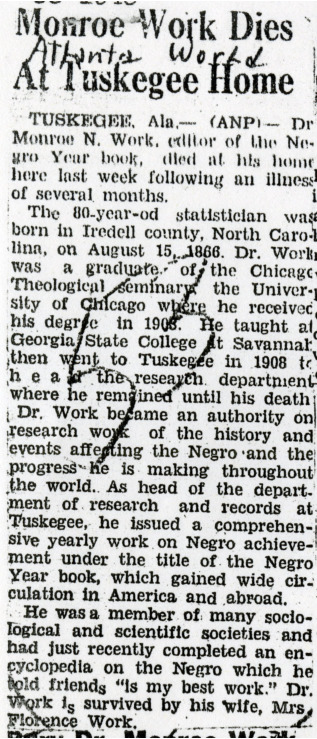
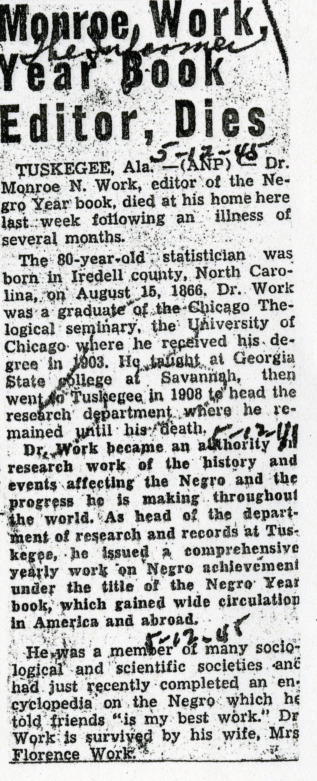
A newspaper obituary article about Dr. Monroe N. Work, a sociologist who founded the Department of Records and Research at Tuskegee University. This article discusses his birthplace, education, and professional achievements throughout his life.
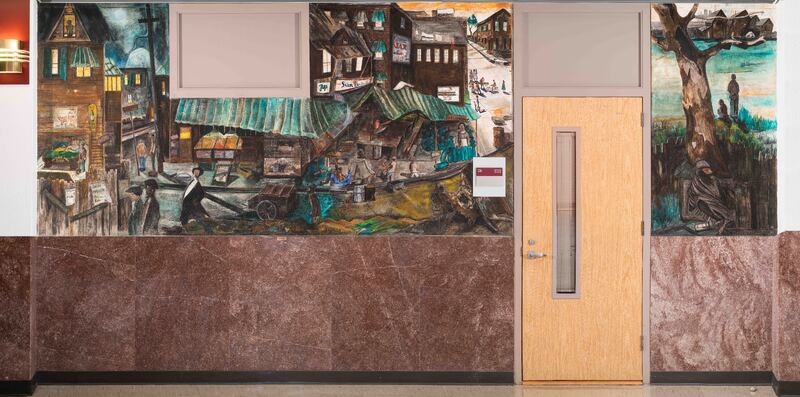
Taylor offers a snapshot of Houston’s Third Ward in the mid-20th century. Growing up in Third Ward, Taylor saw it grow and change. The scene is a busy one and depicts various storefronts and residents of the neighborhood. Taylor named the pool hall in the lower left corner after himself.
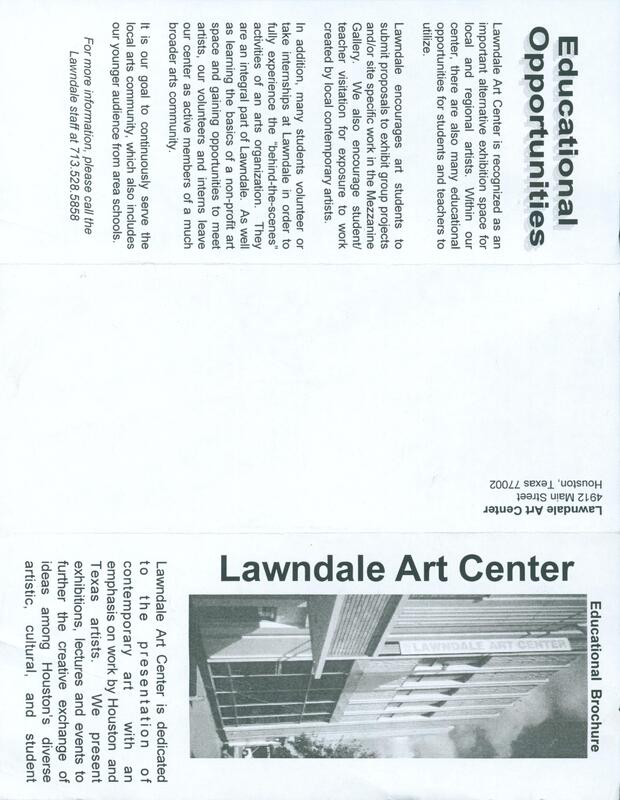
This is a brochure from Lawndale Art Center advertising, among other things, the Otabenga Jones & Associates’ exhibition Symmetrical Patterns of Def. Made up of members Dawolu Jabari Anderson, Jamal Cyrus, Kenya Evans and Robert A. Pruitt, the collective was formed to harness the group's creativity and provide them an entry-point into the art world. The four met and became friends in Harvey Johnson’s drawing class at Texas Southern University.
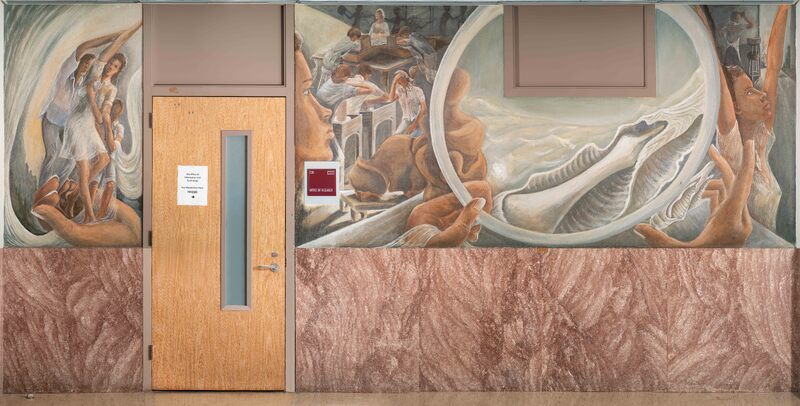
Gordon’s mural examines her own life and personal development. A wispy fabric running through the mural serves as a metaphor for her emerging self-awareness; this motif is found in some of her other works. Gordon’s mural showcases herself working on several art projects from her undergraduate period.
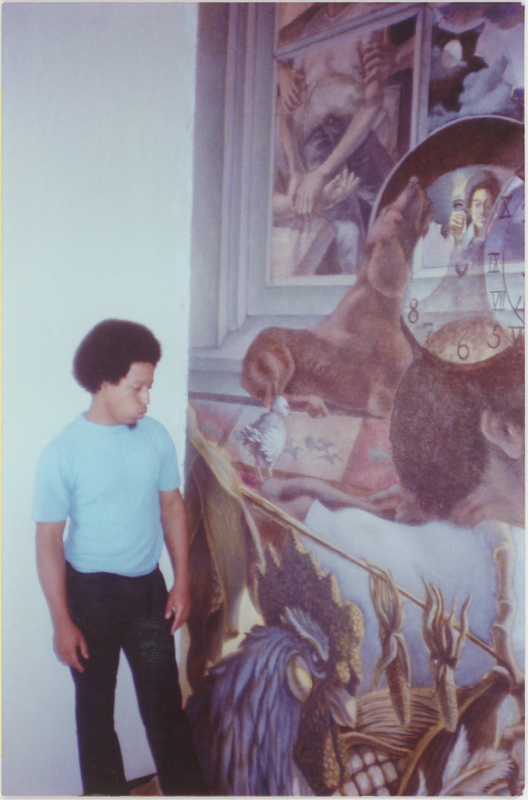
Texas Southern art alumnus Bertram (Bert) Samples is pictured here admiring his mural, which he painted on a first floor wall of Hannah Hall. Samples' mural shows the artist sleeping on his desk after his mother died, dreaming and remembering moments from his life. Samples went on to become one of the founders of Project Rowhouses, a Third Ward-based community art and social impact organization.
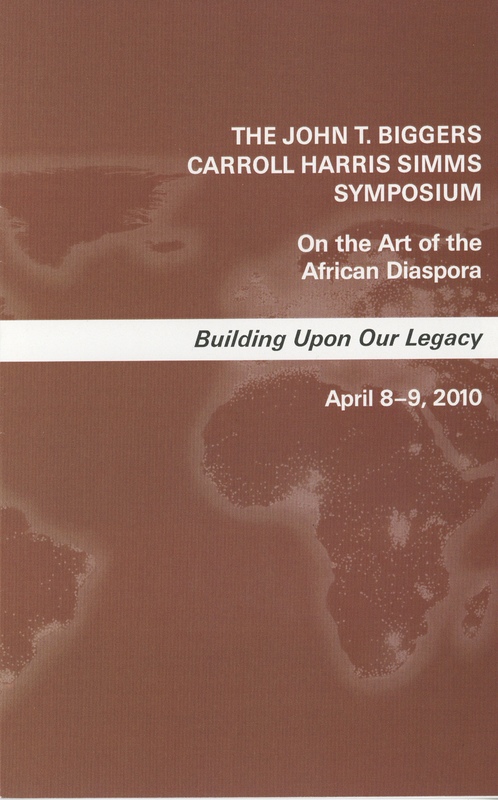
This is a brochure for the April 2010 John T. Biggers Carroll Harris Simms Symposium On the Art of the African Diaspora: Building Upon Our Legacy. This regular event from the University Museum at Texas Southern brings together artists, historians, educators, students, alumni, and members of the public to celebrate the legacy of Biggers and Simms, who worked together to build TSU’s art department from the ground up.
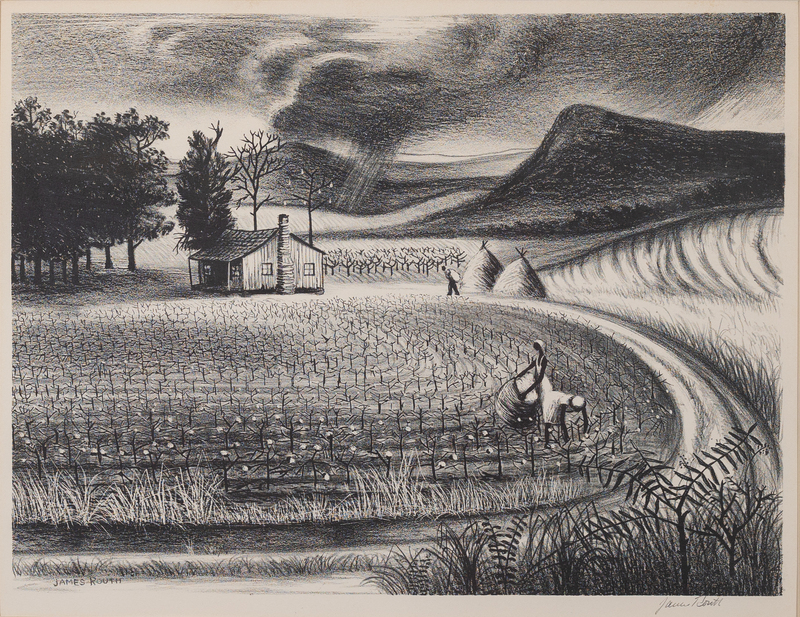
James Routh, Jr. is a painting and printmaker from Atlanta, GA, by way of New Orleans, LA. "Blue Ridge Farm" depicts a rural landscape in the Blue Ridge Mountains, an Appalachian range that extends from Georgia to Pennsylvania. The background shows an atmospheric perspective of two mountains and rain clouds. In the foreground, two women dressed in white are picking cotton while a man behind them carries cotton on his back.
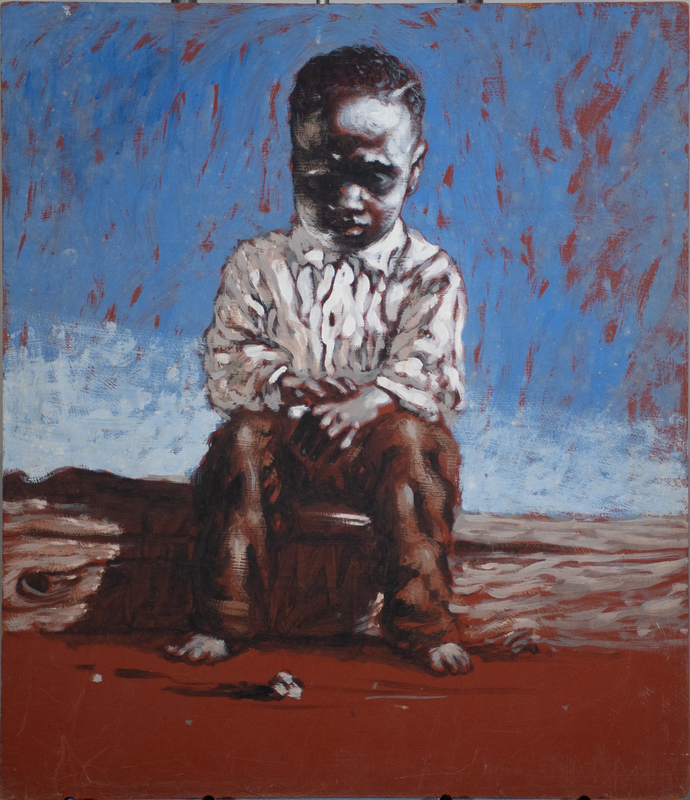
Oliver’s painting depicts a young boy sitting on the stump of a tree. The boy is barefoot and wearing a contemplative expression on his face. Oliver’s style in this painting is very free-form, with quick and abrupt brushstrokes throughout the composition. Oliver is one of the most successful art graduates from TSU, going on to be the only North American artist to design scarves for the fashion house Hermes.
In this interview, former Texas Southern art student Brenda Mackey Lang discusses her time as an art student (1967-73) and as an artist later on. At TSU, Lang learned from Dr. John T. Biggers and Professor Carroll Harris Simms, met Maya Angelou, and protested with Mickey Leland.
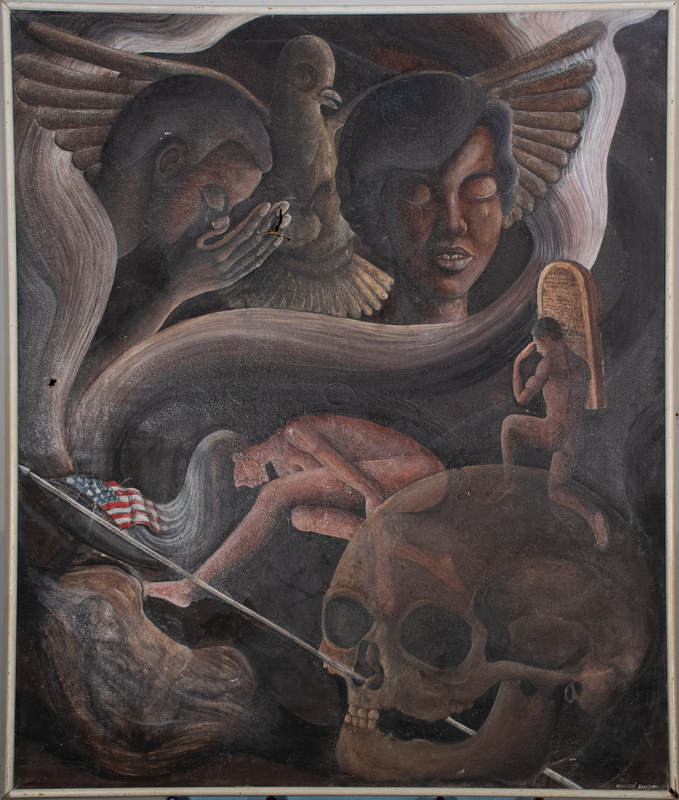
Ellison’s painting reflects the brutality and grief experienced by the Black community. In the foreground, a skull is pierced by the American flag. On the right side, a headstone honoring Martin Luther King, Jr. is surrounded by nude mourners. In the background, a shadowy dove spreads its wings, perhaps representing MLK’s dream of peace being obscured by white supremacist violence.
In this interview, Texas Southern art alumnus Earl Jones, Jr. discusses his experience as a student who graduated in 1996. During his first period of study at TSU, Jones painted a mural reflecting on environmentalism and racism—these themes continue into his current works. Nowadays, Jones primarily creates intricate wood carvings.
In this interview, Texas Southern art alumnus Elizabeth Montgomery Shelton discusses her experiences as a student in the class of 1971. She was a disciple of Professor Carroll Harris Simms and discusses learning to create clay sculptures from him. She went on to teach in Houston public schools for 37 years after her graduation from Texas Southern.
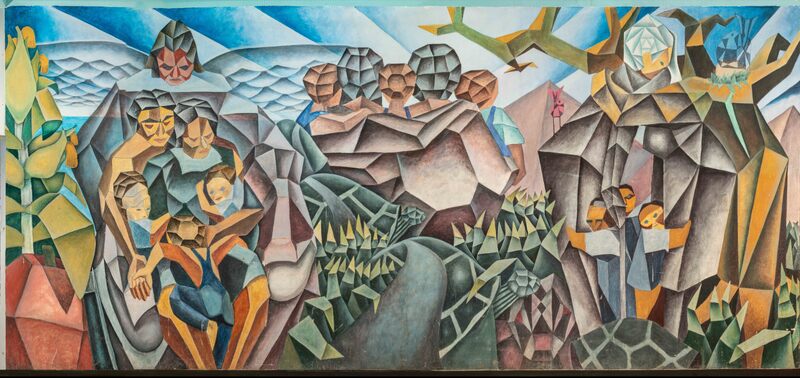
Sifuentes shows multiple generations of a family, painted in a geometric style. Sifuentes borrows visual symbols from his teacher, Dr. Biggers, including the tortoise (longevity) and the serpent (danger and rebirth). Guardian ancestors are represented by figures with angel wings.
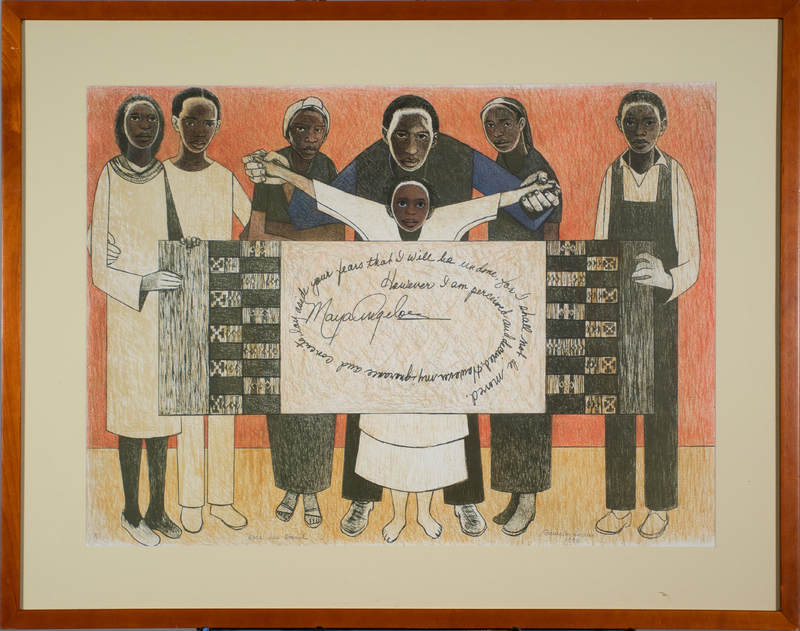
Lewis’s print shows a group of people holding a Kente-style textile, inscribed with the words, “However I am perceived and deceived, however my ignorance and conceits, lay aside your fears that I will be undone, for I shall not be moved," a selection from Maya Angelou’s poem Our Grandmothers; John Biggers also created illustrations to accompany Angelou's poem. Lewis was a leading African-American artist and art historian. She and Biggers studied together at Hampton University.
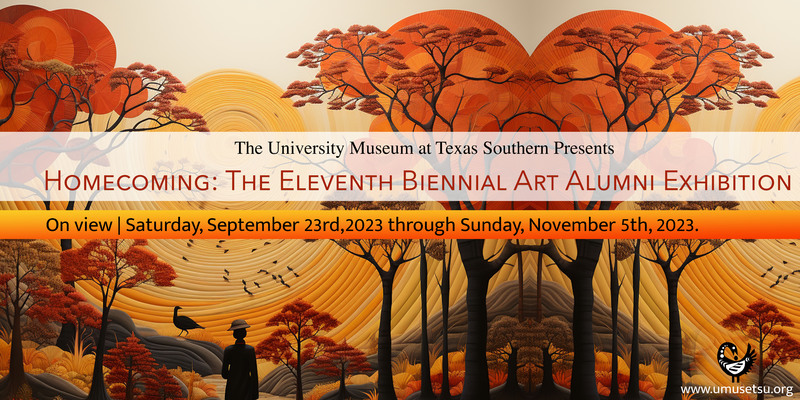
This is a digital flyer for the Fall 2023 Homecoming: The Eleventh Biennial TSU Art Alumni Exhibition at the University Museum at Texas Southern. The University Museum hosts an art alumni exhibition every other fall, alternating with an art faculty exhibition. Alumni showcase their artwork, which ranges from paintings, prints, and photographs to sculpture, jewelry, and wood carving.
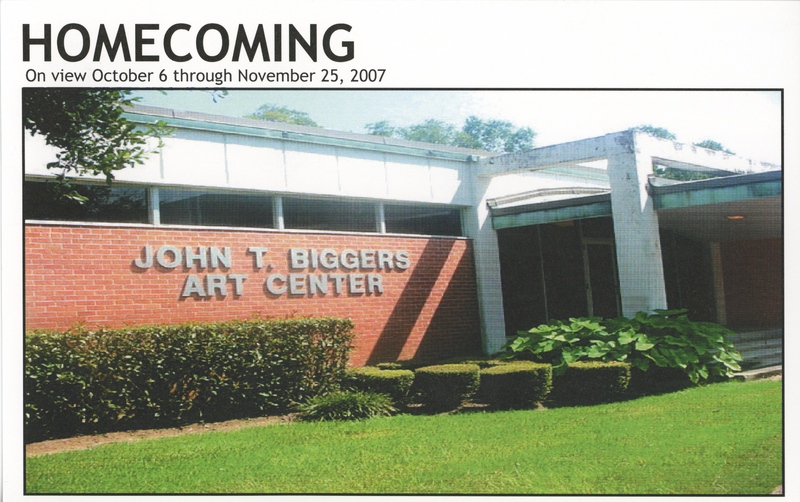
This is an invitation to the Fall 2007 Homecoming: The Third Biennial TSU Art Alumni Exhibition at the University Museum at Texas Southern. The University Museum hosts an art alumni exhibition every other fall, alternating with an art faculty exhibition. Alumni showcase their artwork, which ranges from paintings, prints, and photographs to sculpture, jewelry, and wood carving.
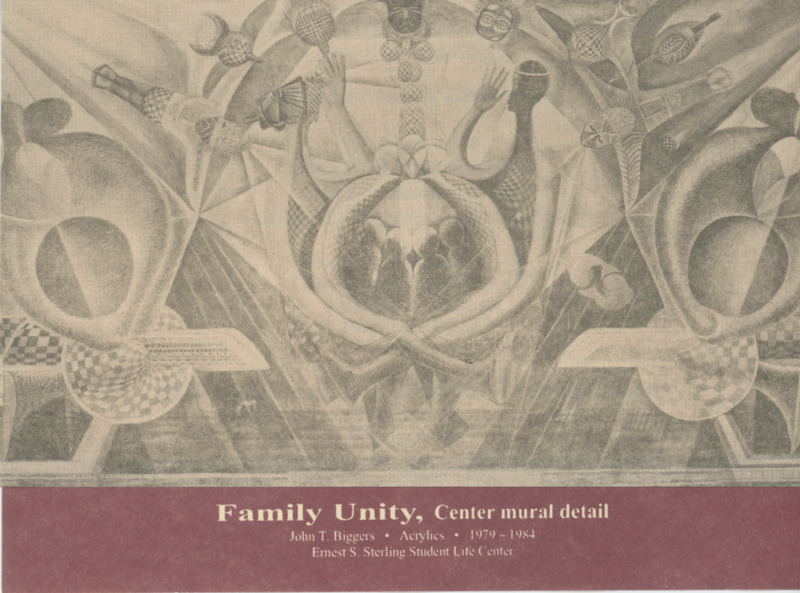
This is an invitation to Texas Southern University's Fall 1995 convocation and the dedication of the John T. Biggers Art Center. Biggers founded the university’s art department in 1949 and taught classes until 1983. The invitation features a detail shot of Biggers’ mural Family Unity, which is located in the cafeteria of the Sterling Student Life Center on TSU’s campus. The invitation is printed in TSU’s maroon and gray colors.
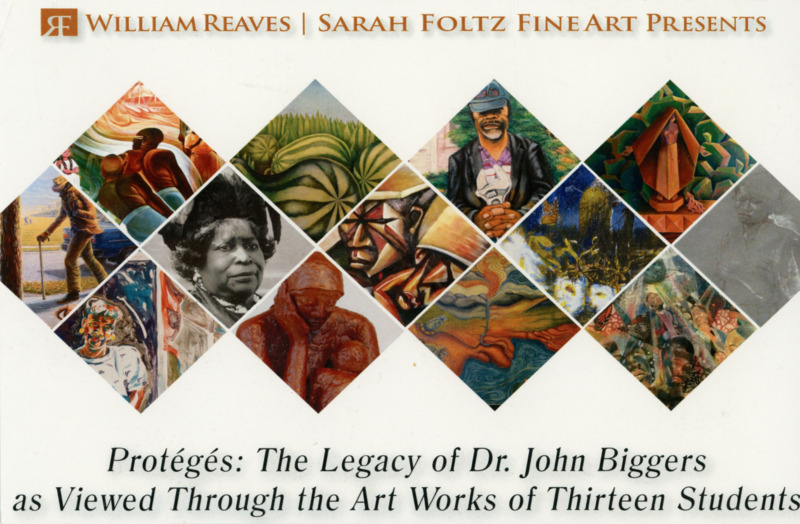
This is an invitation from William Reaves - Sarah Foltz Fine Art gallery to the exhibition Protégés: The Legacy of John Biggers As Viewed Through the Artworks of Thirteen Students. The featured artists - Charles Criner, Geraldine Crossland, Karl E. Hall, Earlie Hudnall, Jr., Harvey Johnson, Earl S. Jones, Josie Mendoza Postel, Robert Meyers, Elizabeth Montgomery Shelton, Kermit Oliver, Jesse Sifuentes, Charles Thomas, and Roy Vinson Thomas - are all Texas Southern alumni and students of Dr. Biggers.
A commentary on the conflict between technology and progress, history and culture, Davis painted this mural in response to the destruction of several Hannah Hall murals to create windows into a new computer lab. Davis’ own mural was later damaged by subsequent construction, as foreseen in its design.
In this interview, Texas Southern art alumnus Johnetta Tinker discusses her experiences as a student in the class of 1972. As a student, she worked closely with Dr. Biggers and would sneak into his studio to watch him work. She recalls a strong sense of camaraderie with her classmates. After TSU, she was mentored by Boston artist Allen Crite.
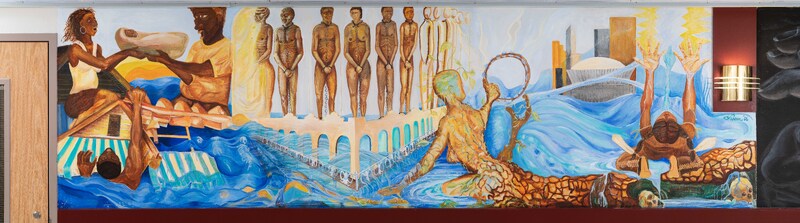
A native of New Orleans, Green transferred to TSU’s art program following Hurricane Katrina. His mural ties different aspects of New Orleans history and culture together through floodwaters. Enslaved ancestors stand at auction, and the city skyline, including the Superdome, is featured prominently.
In this interview, Texas Southern art alumnus Kermit Oliver discusses his time at Texas Southern (1962-1967) and his artistic philosophy & practice with Dr. Alvia J. Wardlaw, director and curator of the University Museum. He highlights the religious, personal, historical, and political influences that shape his artwork.
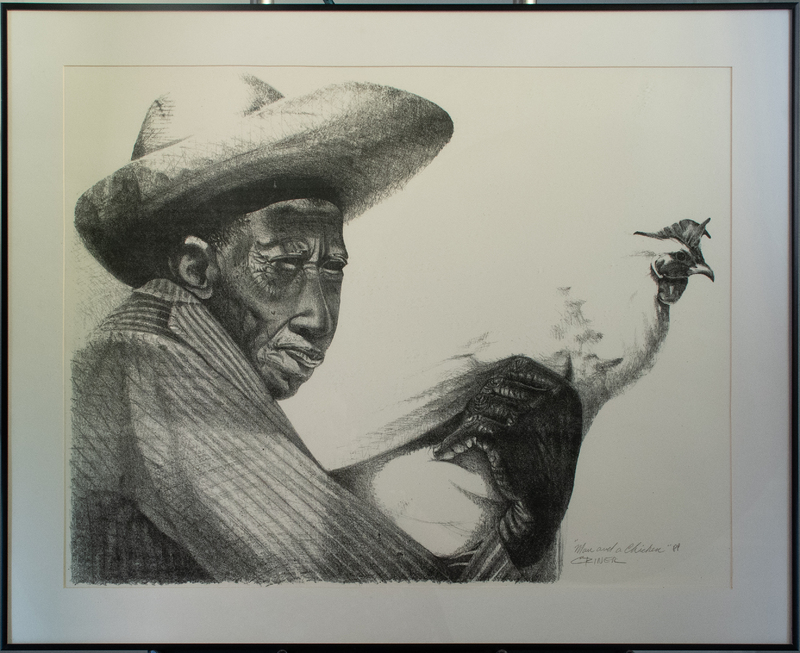
Criner’s print shows an older man wearing a hat and holding a chicken. This print is a black-and-white version of Criner’s piece “Mr. Alvin White, Man With Chicken.” Criner learned printmaking firsthand from Dr. John Biggers and was the longtime artist-in-residence at Houston’s Museum of Printing History.
In this interview, Texas Southern art alumnus Moses Adams, Jr. discusses his experiences as a student in the class of 1969. He found his undergraduate courses challenging because he lacked a deep background in art, and the TSU faculty had high standards. Adams created a sprawling, abstract mural reflecting on drug addiction and urban decay.