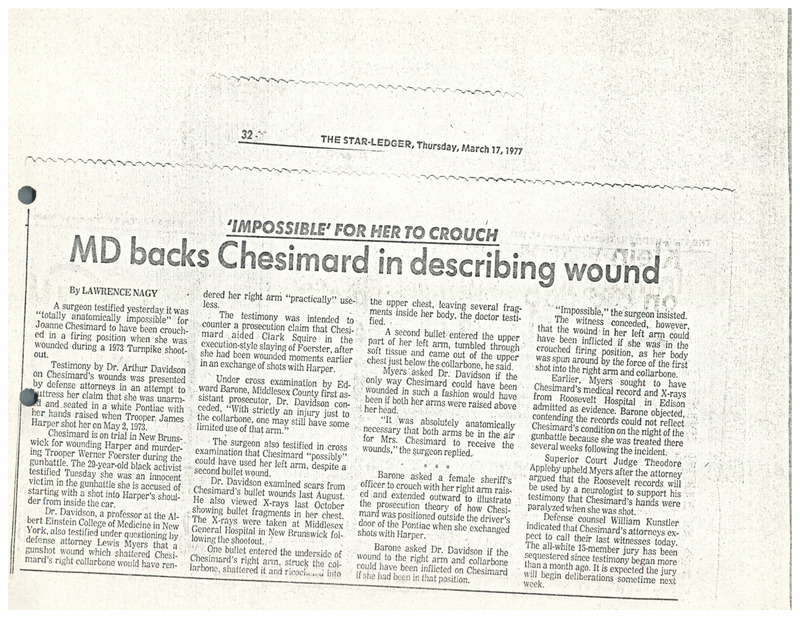
A newspaper article from The Star-Ledger about the testimony of defense witness Dr. Arthur Davidson during the trial of Assata Shakur (JoAnne Chesimard) for the 1973 killing of a state trooper. He testified about the wounds sustained by Shakur and argued that she could not have shot from the crouching position due to her wounds from the shootout.
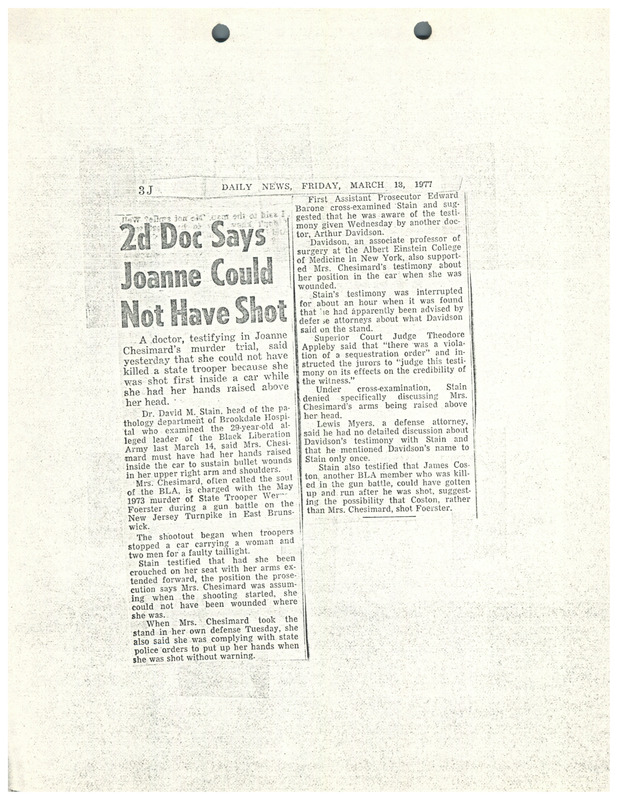
A newspaper article from Daily News about the testimony of defense witness Dr. David Spain during the trial of Assata Shakur (JoAnne Chesimard) for the 1973 killing of a state trooper. He testified about the wounds she sustained, arguing that she couldn’t have shot from a crouching position due to the position of her wounds from the shootout.
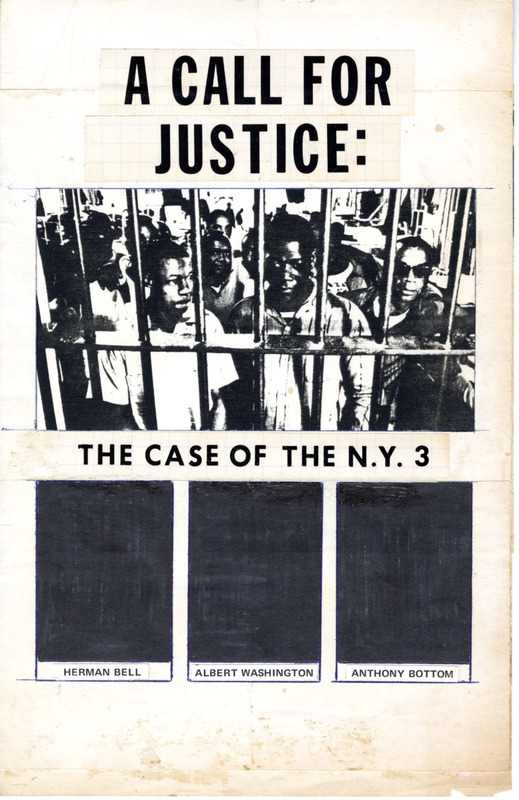
A handmade flier with a picture of prisoners behind bars. The pictures of Herman Bell, Albert Washington, and Anthony Bottom have been blacked out. The three men, known as the New York 3, were Black Panther Party and Black Liberation Army (BLA) members who were arrested and convicted of the May 21, 1971, killing of two police officers in Harlem.
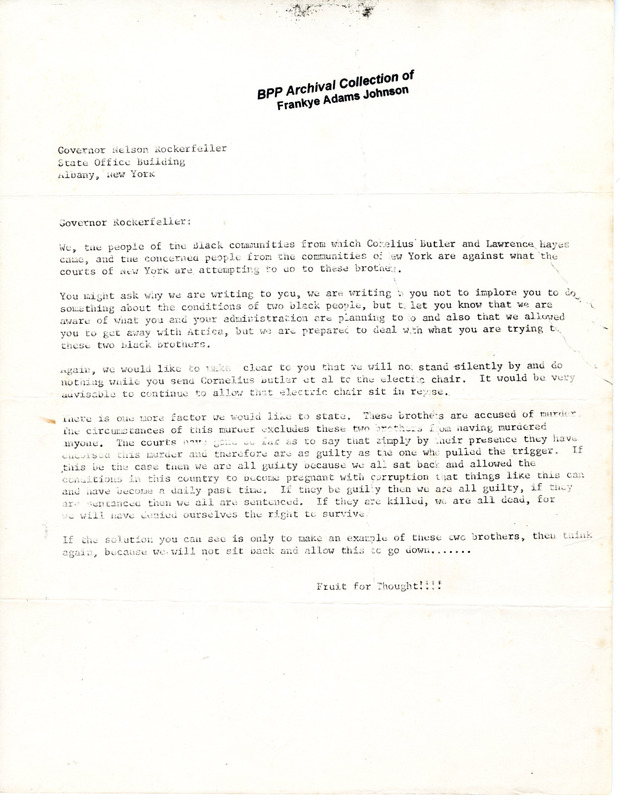
A letter to New York Governor Nelson Rockefeller on behalf of Cornelius Butler and Lawrence Hayes, who were being tried for murder. The men were convicted to the death penalty on April 11, 1972, for their role in the hold-up of a convenience store and the murder of a police officer. Supporters contend that neither of the men fired the shots.
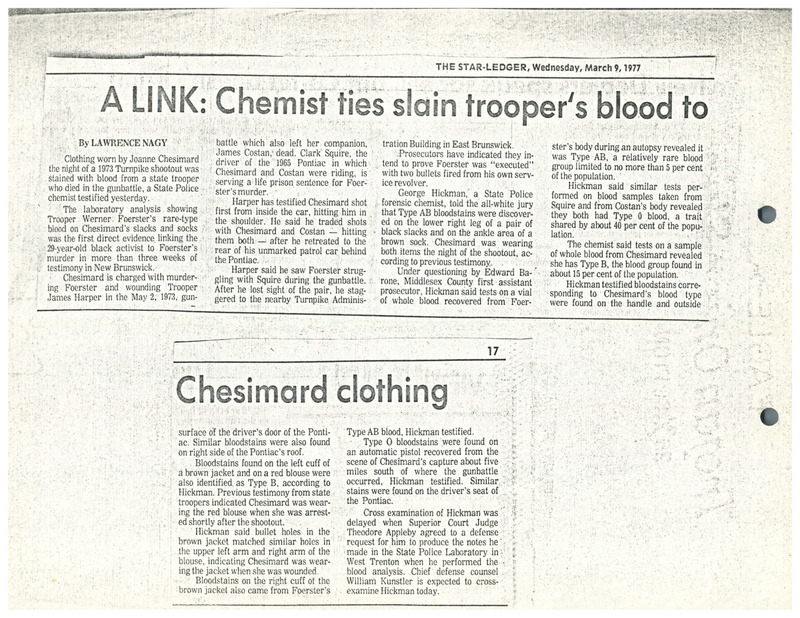
A newspaper article from The Star Ledger about evidence in the trial of Assata Shakur (JoAnne Chesimard) for the 1973 killing of a state trooper. Prosecution witnesses showed that blood found on the clothes of Assata Shakur (JoAnne Chesimard) matched the rare AB blood type of the slain state trooper.
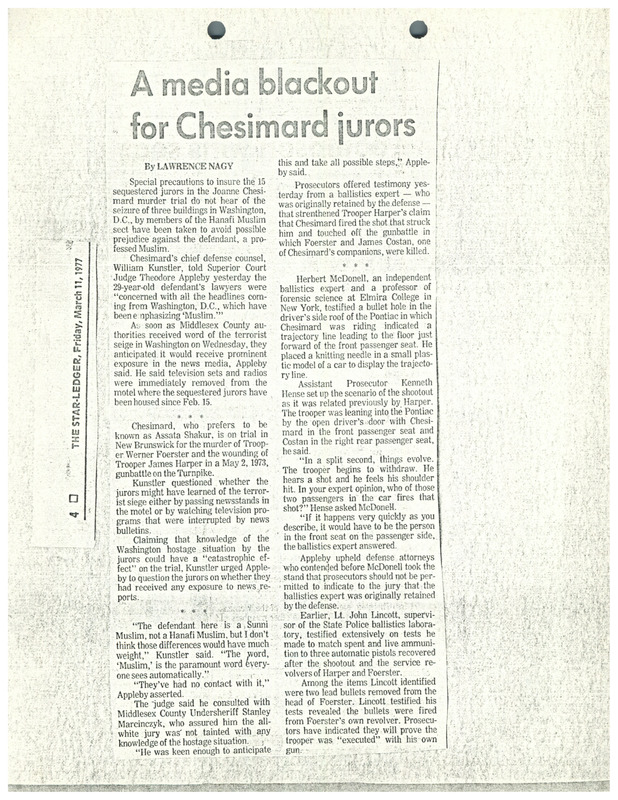
A newspaper article from The Star Ledger about the 15 sequestered jurors in the Assata Shakur (JoAnne Chesimard) trial for the 1973 killing of a state trooper being given a media blackout after the seizure of three buildings in Washington, D.C. by the Hanafi Muslim sect to avoid possible prejudice against Shakur, a professed Muslim.
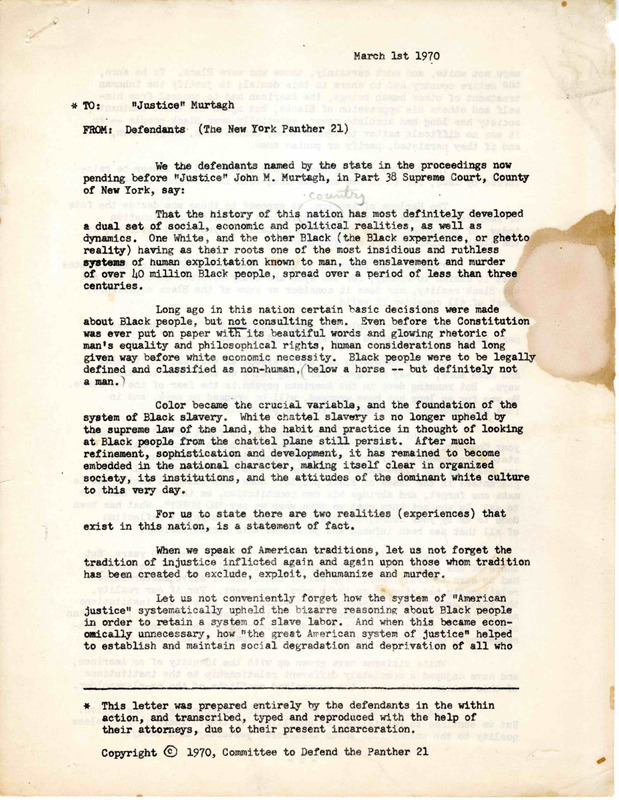
A letter from the Panther 21 to New York State Supreme Court Justice John M. Murtagh. The Panther 21 was a group of Black Panthers who were on trial for alleged bombing attacks against three police stations in New York City in 1969. The letter is an indictment of the American justice system where the 21 Black Panthers find themselves on trial.
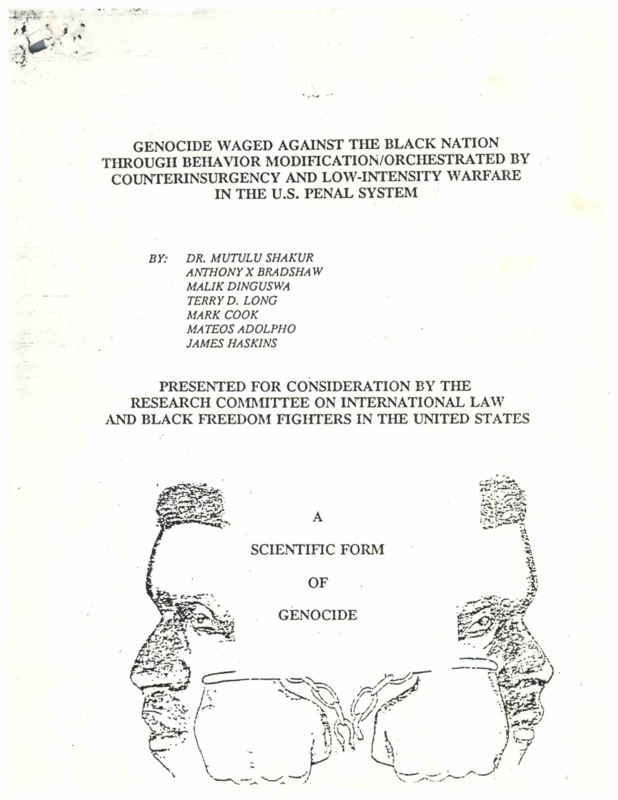
A paper by a team of Black prisoners who experienced behavior modification in prison. In this paper they argue that Black prisoners being given behavior modification is a form of genocide against Black people. The paper was presented for consideration by the Research Committee on International Law and Black Freedom Fighters in the United States.
A paper by Dr. Mutulu Shakur that argues the existence of political prisoners reveals the violations of human rights perpetuated by the United States government against Black people. Dr. Shakur wrote this from prison, where he was serving a 60 year sentence for his role in a Black Liberation Army (BLA) led robbery in 1981.
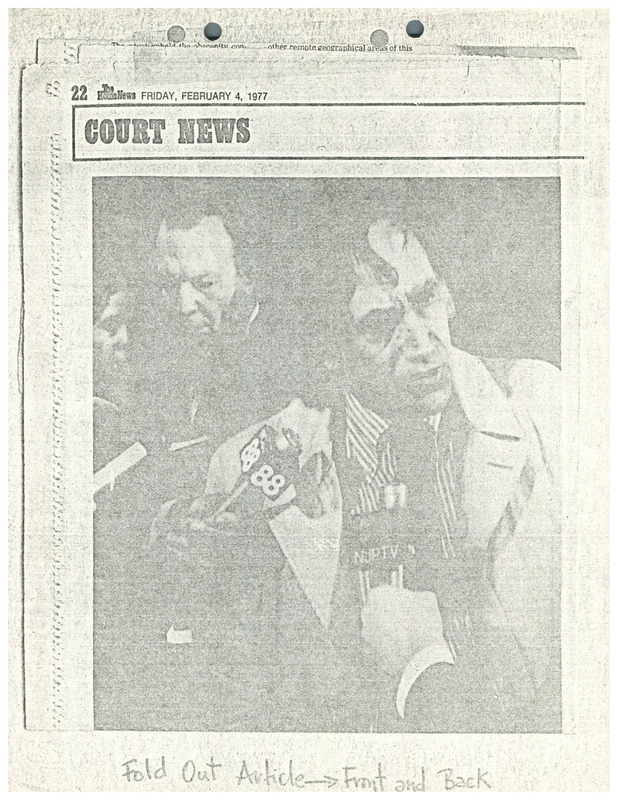
A cover photograph from the Court News Section of the newspaper The Home News featuring members of the defense team for Assata Shakur (JoAnne Chesimard) who was on trial for the 1973 killing of a state trooper. Shakur was convicted in 1977 of killing the state trooper during a shootout, escaped prison in 1979, and is still wanted by the FBI.
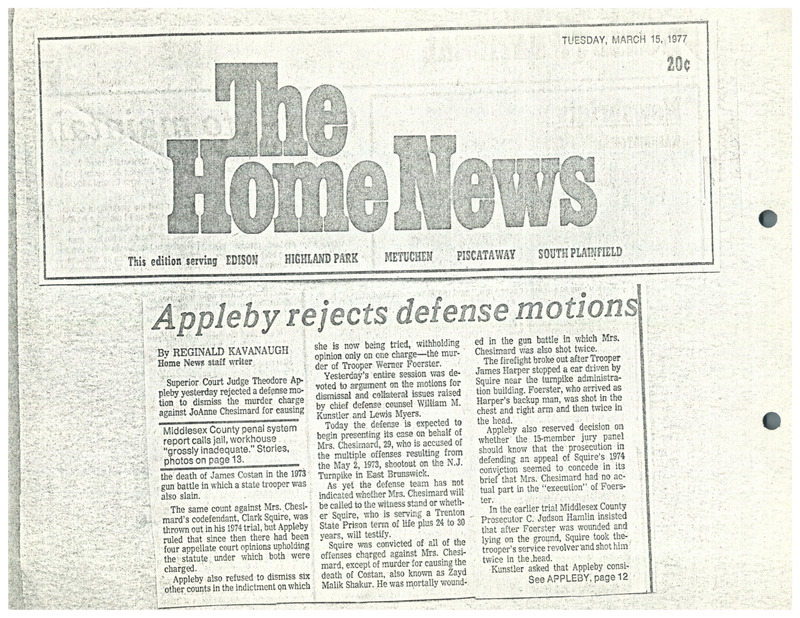
A newspaper article from The Home News about a day long juryless court session where defense lawyers made numerous motions to dismiss the indictments against Assata Shakur (JoAnne Chesimard) who was on trial for the 1973 killing of a state trooper. The judge rejected these motions and the attorneys are scheduled to call witnesses that day.
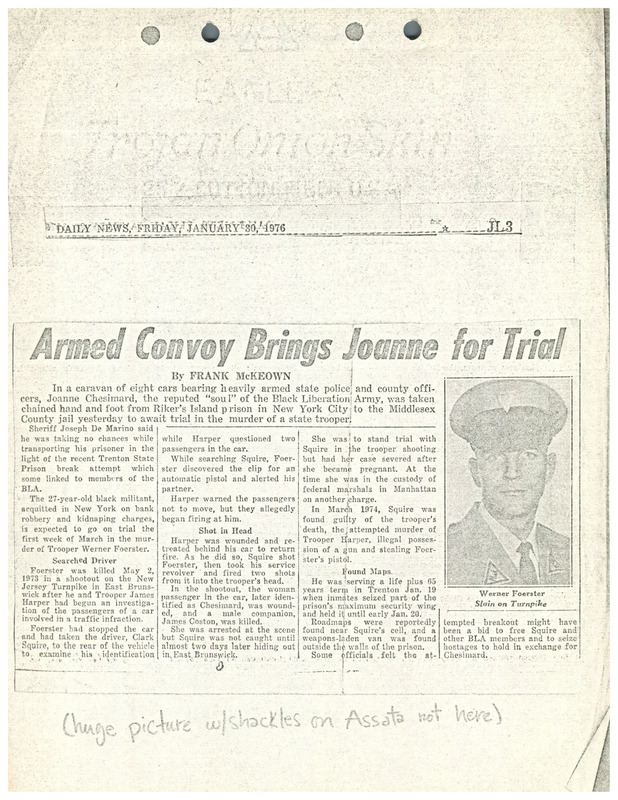
A newspaper article from Daily News about Assata Shakur (JoAnne Chesimard) being in New Jersey to stand trial for the May 1973 killing of a state trooper. Shakur was convicted in 1977 of killing the state trooper during a shootout, escaped prison in 1979, and is still wanted by the FBI.
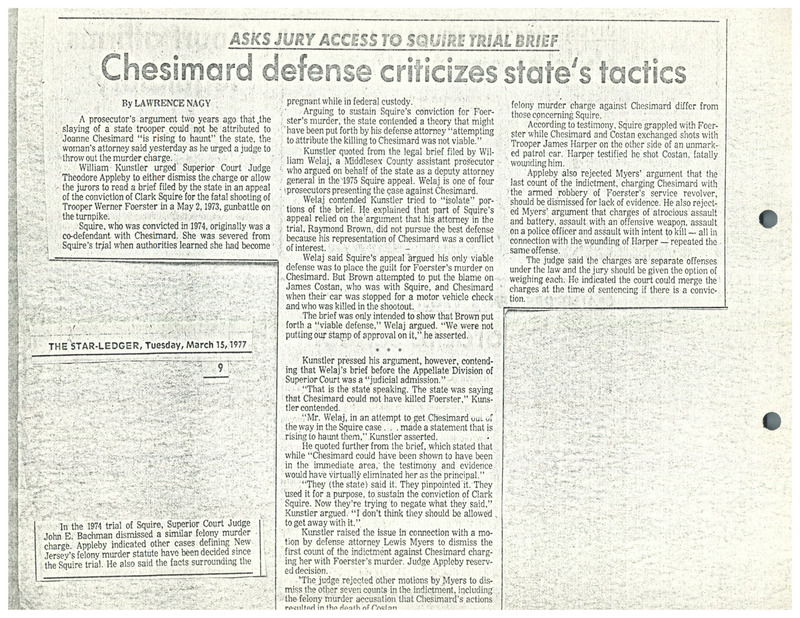
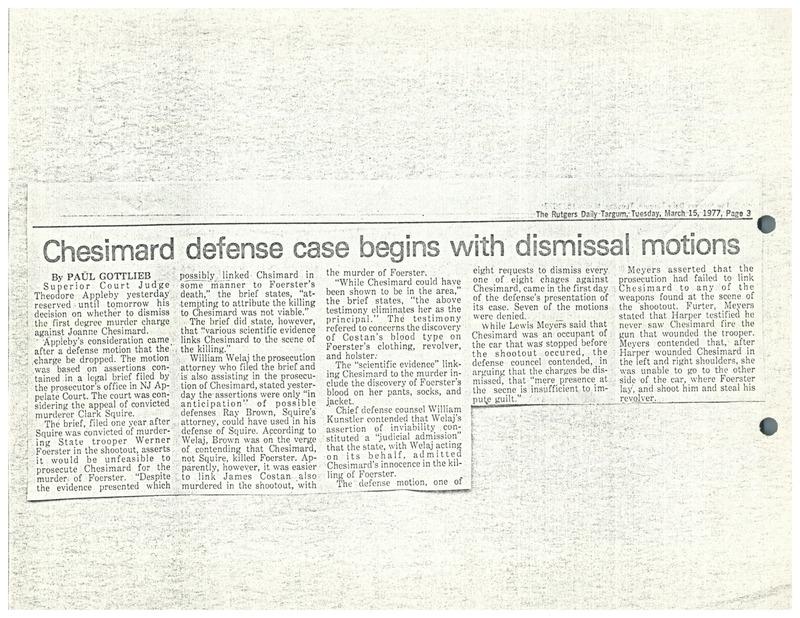
A newspaper article from The Star Ledger about the defense team for Assata Shakur (JoAnne Chesimard), who was on trial for the 1973 killing of a state trooper, opening their case by calling for dismissal of the murder charge on the grounds that she cannot be convicted since Clark Squire has already been convicted of the killing.
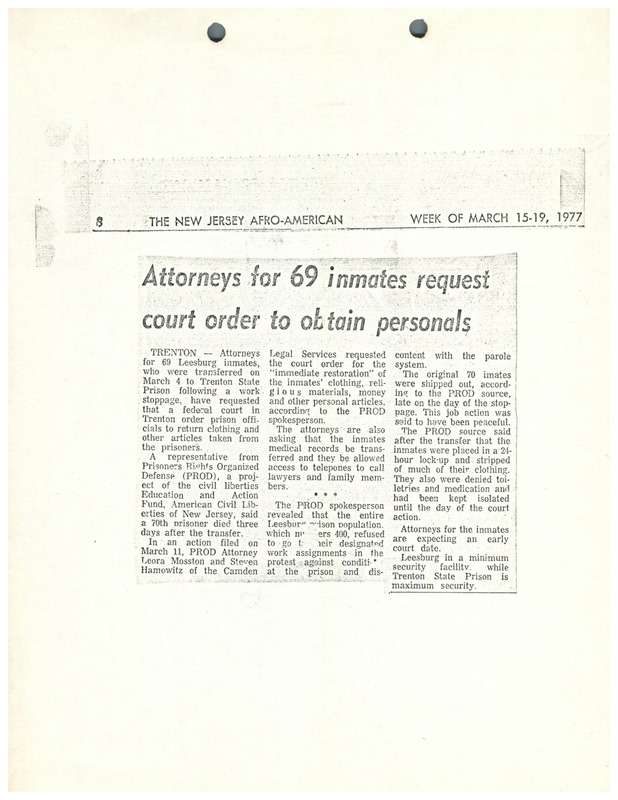
A newspaper article from The New Jersey Afro-American about prisoners who refused work assignments as a protest over living conditions. The prisoners were transferred and denied their personal belongings, telephone calls, and medical care. The group Prisoner’s Rights Organized Defense (PROD) asked a judge to restore everything for the inmates.
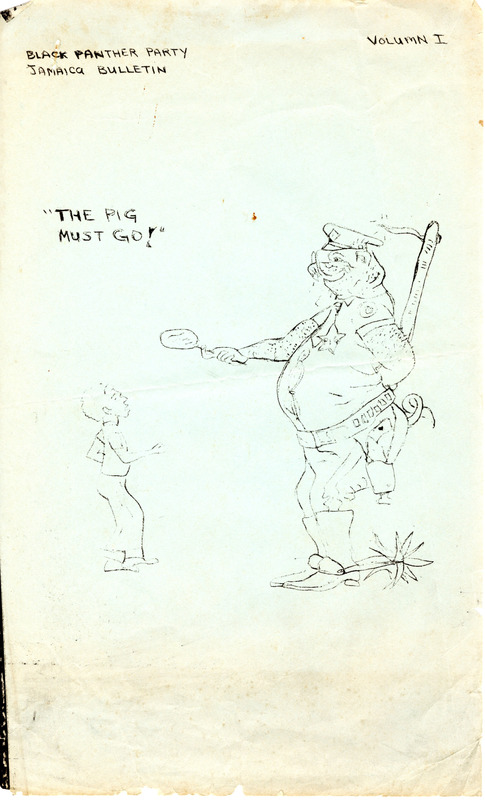
Volume 1 of The Black Panther Party Jamaica Bulletin from Jamaica Queens, NY, February 28, 1969. Included in the bulletin are a political cartoon titled "The Pig Must Go"; an article titled "Panthers Harassed by F.B.I."; and an abridged version of Black Panther Party Ten Point Program.
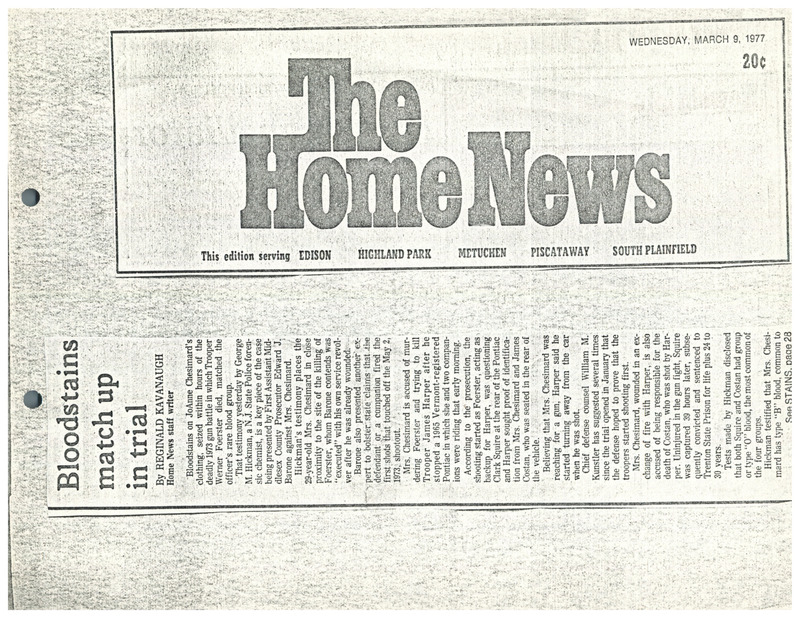
A newspaper article from The Home News about evidence in the trial of Assata Shakur (JoAnne Chesimard) for the 1973 killing of a state trooper. Prosecution witnesses showed that blood found on the clothes of Assata Shakur (JoAnne Chesimard) matched the rare AB blood type of the slain state trooper.
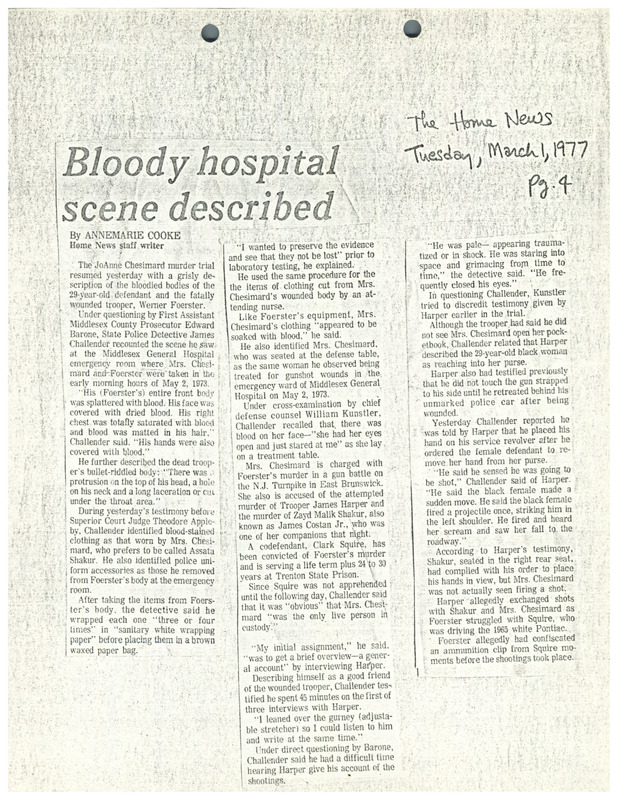
A newspaper article from The Home News about the testimony of State Police Detective James Challender describing what he saw at the emergency room where Assata Shakur (JoAnne Chesimard) and wounded state trooper Werner Foerster were taken after he was fatally shot. Shakur was on trial for the 1973 murder of Foerster.
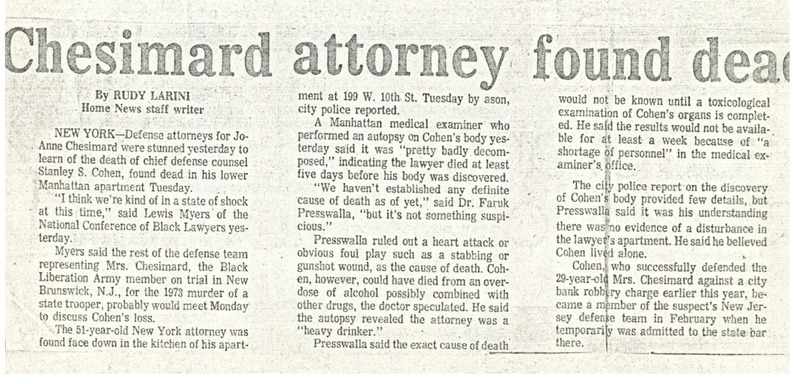
A newspaper article from The Home News about Stanley Cohen, the chief defense counsel in the murder trial of Assata Shakur (JoAnne Chesimard) for the 1973 killing of a state trooper, being found dead in his Manhattan apartment. At the time of reporting, the cause of death was unknown.
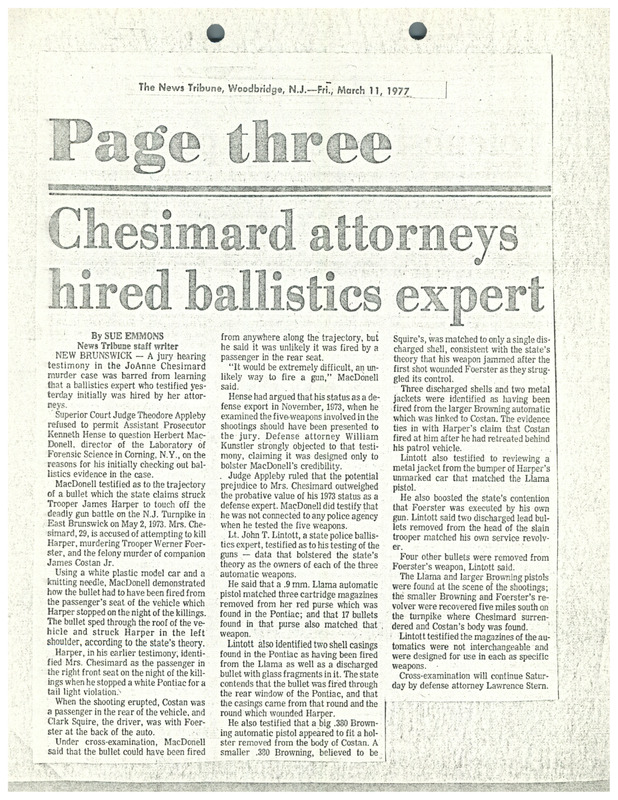
A newspaper article from The News Tribune about testimony on ballistics and gunshot trajectories given by two different expert witnesses in the trial of Assata Shakur (JoAnne Chesimard) for the 1973 killing of a state trooper. The judge in the case barred the jury from learning that one of the experts was hired by the defense.
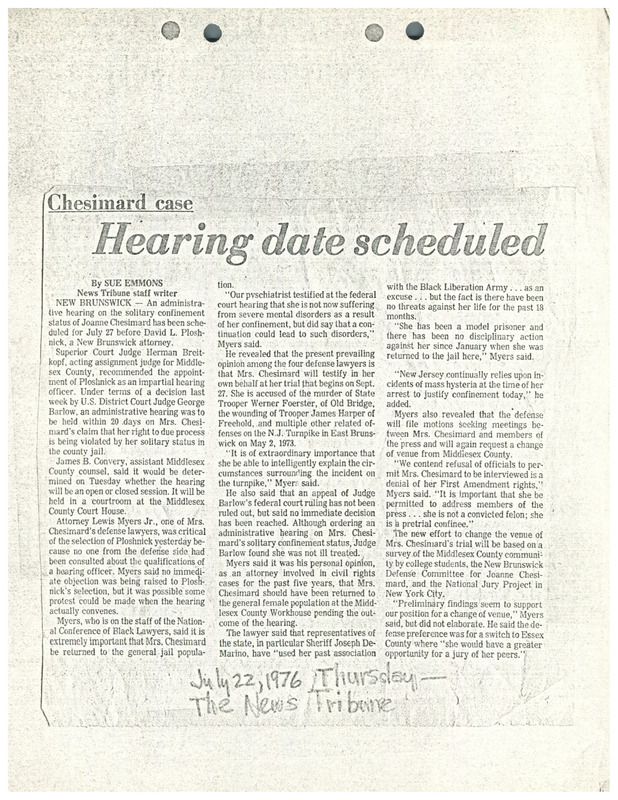
A newspaper article from The News Tribune about an administrative hearing for Assata Shakur (JoAnne Chesimard) being scheduled for July 27th. The hearing will determine if Assata Shakur (JoAnne Chesimard) should be moved out of solitary confinement and into women's general population. She was on trial for the 1973 killing of a state trooper.
A newspaper article from The Rutgers Daily-Targum about the defense team for Assata Shakur (JoAnne Chesimard), who was on trial for the 1973 killing of a state trooper, opening their case by calling for dismissal of the murder charge on the grounds that she cannot be convicted since Clark Squire has already been convicted of the killing.
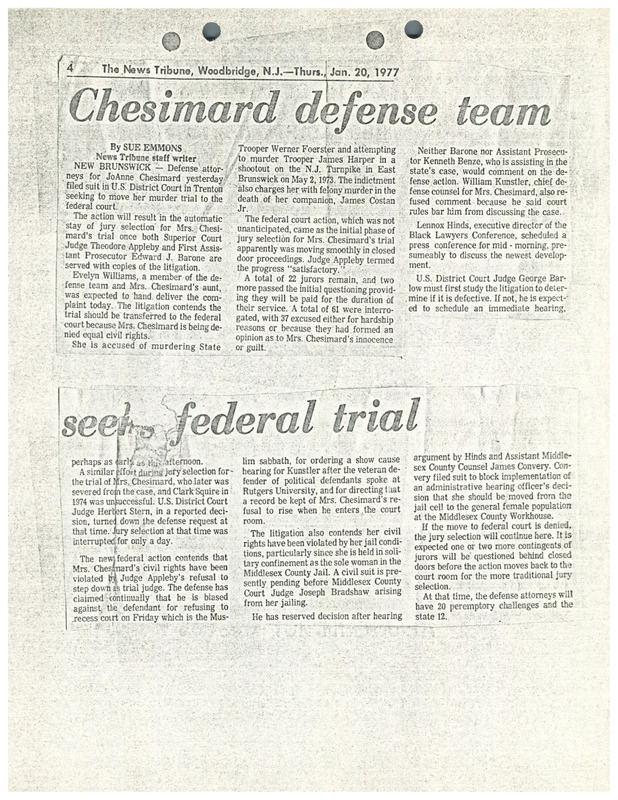
A newspaper article from The News Tribune about defense attorneys for Assata Shakur (JoAnne Chesimard) filing suit to move her trial for the 1973 killing of a state trooper to the federal court. They contend that her civil rights are being violated in at least two ways. The litigation came during jury selection.
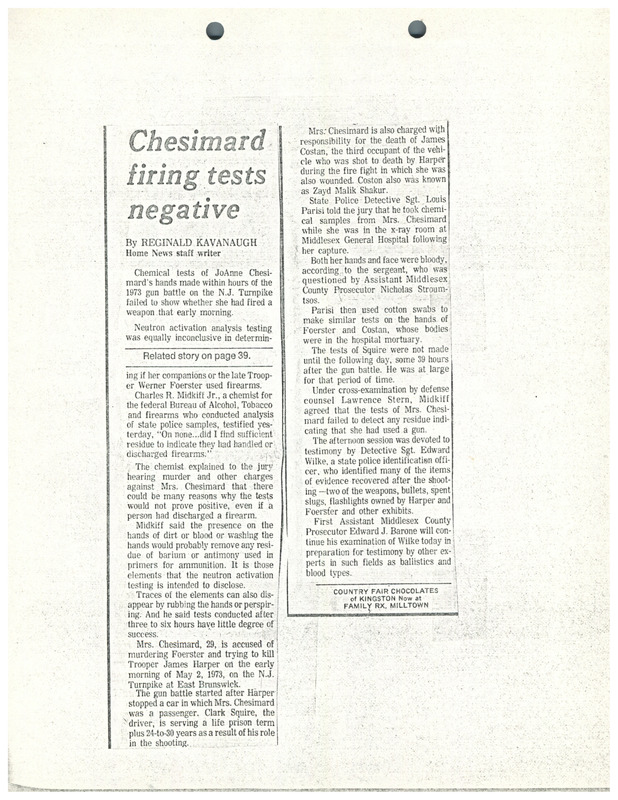
A newspaper article from Home News about chemical and neutron activation tests both being inconclusive on the matter of whether Assata Shakur (JoAnne Chesimard), the other defendants, or the state trooper had fired the gun in question in Shakur’s trial for the 1973 killing of a state trooper.
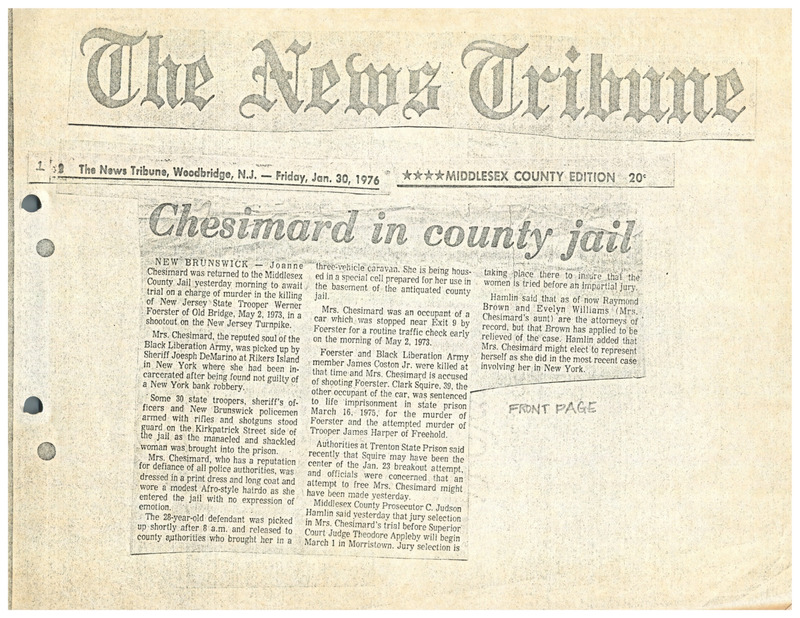
A newspaper article from The News Tribune about Assata Shakur (JoAnne Chesimard) being in New Jersey to stand trial for the May 1973 killing of a state trooper. Shakur was convicted in 1977 of killing the state trooper during a shootout, escaped prison in 1979, and is still wanted by the FBI.
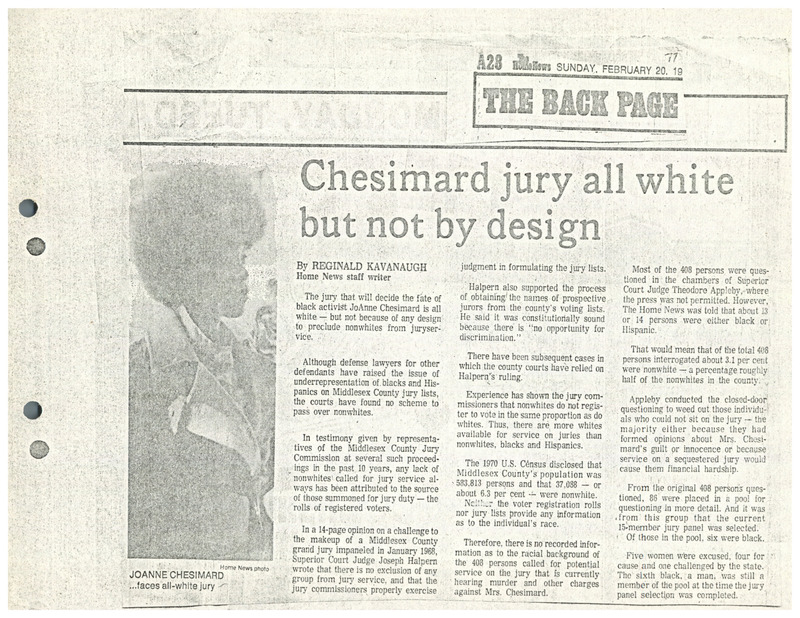
A newspaper article from The Home News about the all white jury in the murder trial of Assata Shakur (JoAnne Chesimard) for the 1973 killing of a state trooper. Courts have decided that the jury selection is fair since the selections are made from voter registration rolls. Shakur was convicted in 1977 of the killing and escaped prison in 1979.
A newspaper article from The Star Ledger about bullet fragments the prosecution is putting into evidence in what they hope is the last week in their case against Assata Shakur (JoAnne Chesimard) for the 1973 killing of a state trooper. Defense attorneys questioned if the fragments were marked on the scene in an unusual way.
A newspaper article from The Star Ledger about the defense team for Assata Shakur (JoAnne Chesimard) being rejected in their motion to have a mistrial called after disturbances in the courtroom on March 2, 1977, during Shakur’s trial for the 1973 killing of a state trooper. The article also discusses physical evidence presented by the prosecution.
A newspaper article from The News Tribune about the defense team for Assata Shakur (JoAnne Chesimard), on trial for the 1973 killing of a state trooper, being denied calling an extra ballistics witness by the judge. The prosecution contended the witness was not valid since the defense team missed the cutoff date to add witnesses to their list.
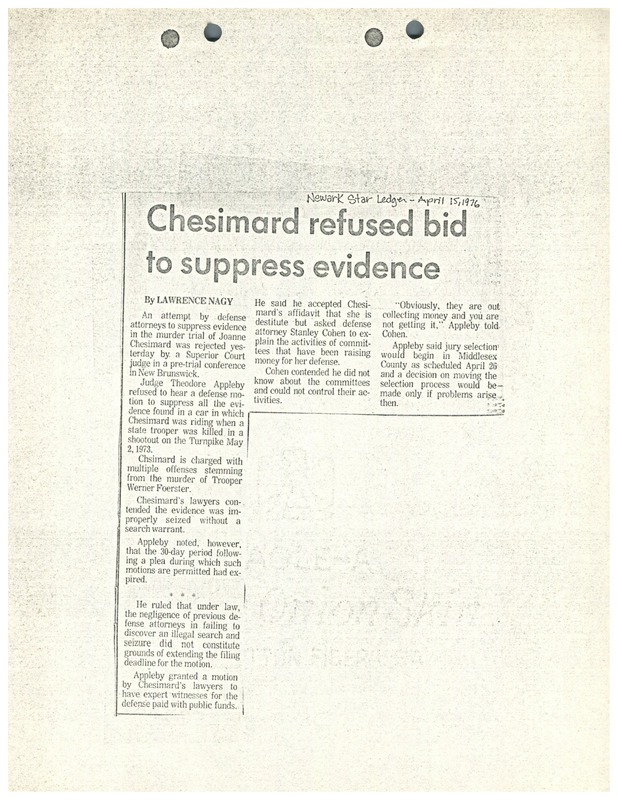
A newspaper article from the Star Ledger about the defense team in Assata Shakur's (JoAnne Chesimard) trial being denied a motion to suppress evidence found in the car after the May 1973 shootout. Shakur was convicted in 1977 of killing the state trooper during a shootout, escaped prison in 1979, and is still wanted by the FBI.
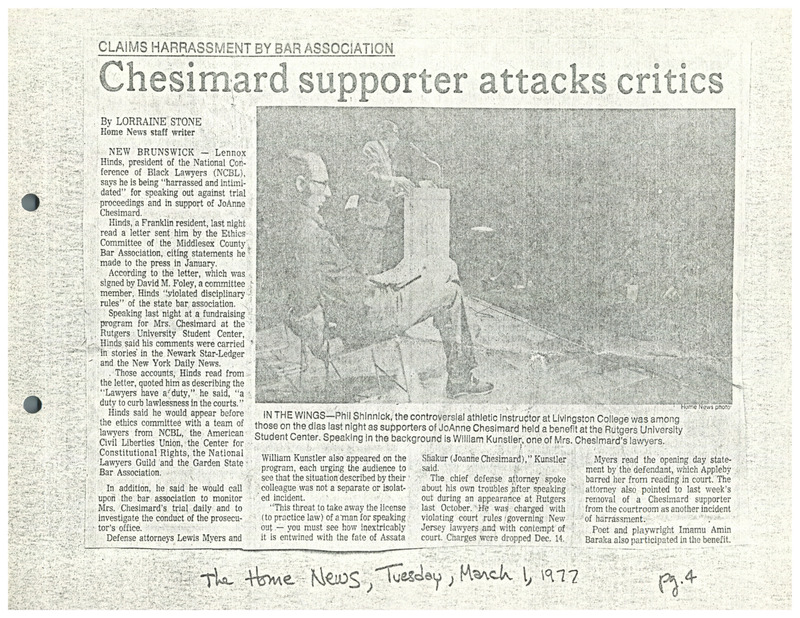
A newspaper article from The Home News about Lennox Hinds, president of the National Conference of Black Lawyers, being cited by The Ethics Committee of the Middlesex County Bar Association for statements he made to the press against critics of Assata Shakur (JoAnne Chesimard), who was on trial for the 1973 killing of a state trooper.